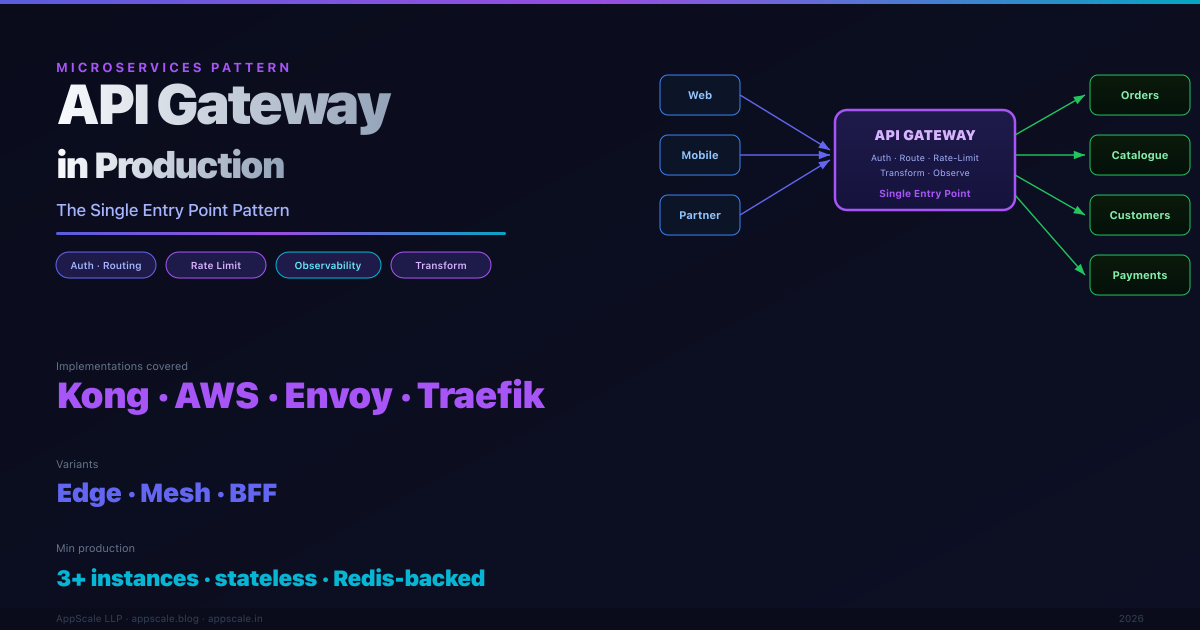
API Gateway in Production: The Single Entry Point Pattern (2026)


A production-grade deep-dive into the sidecar pattern — covering Kubernetes, ECS, and VM deployment models, Envoy and Fluent Bit resource sizing, service mesh trade-offs (Istio vs Dapr), graceful shutdown ordering, and the real cost of 200 pods of sidecars.
Synchronous request-reply is the easy default. It also breaks at exactly the moment the system starts to matter — slow downstream services, deployment coordination across teams, back-pressure cascades that turn local hot spots into system-wide outages. Event-driven architecture replaces the implicit call graph with an explicit event log: producers publish facts, consumers subscribe and react in their own time, and the contract is a versioned schema in a registry. This article is the broker-and-contract perspective on event-driven architecture: choosing between Kafka, SNS+SQS, NATS, EventBridge, and Pulsar; schema registry discipline and contract evolution; idempotent consumers and at-least-once delivery; ordered partitioning and throughput; dead-letter queues; production configuration values; and the anti-patterns that defeat the pattern.
A production-grade deep-dive into the ambassador pattern — covering outbound proxy architecture with Envoy, per-dependency retry policies, connection pooling, circuit breaking, protocol translation, and the decision framework for choosing between ambassadors, sidecars, and service meshes.
Almost every interesting endpoint in a modern system is an enrichment endpoint — assembling a response from eight or twelve upstream services. Sequential chaining produces a sum-of-dependencies latency floor; one failed dependency takes the whole endpoint down. The async parallel enrichment pattern replaces the chained sequence with a fan-out: every independent enrichment is fired in parallel, the responses are gathered with a deadline, and the assembly step copes gracefully with the responses that did not arrive in time. This article walks through the discipline the pattern actually requires — Promise.allSettled, per-call timeouts composed from the outside in, AbortController-based cancellation, request coalescing and DataLoader-style deduplication, the required-vs-optional API contract, partial-aware response schemas, per-dependency observability, and the configuration values that work in production.
Advertise and partner
Reach engineering leaders and CTOs reading about AI, mobile and cloud architecture.
Sponsored mentions and co-authored articles or technical deep-dives. Relevant products only, always disclosed.