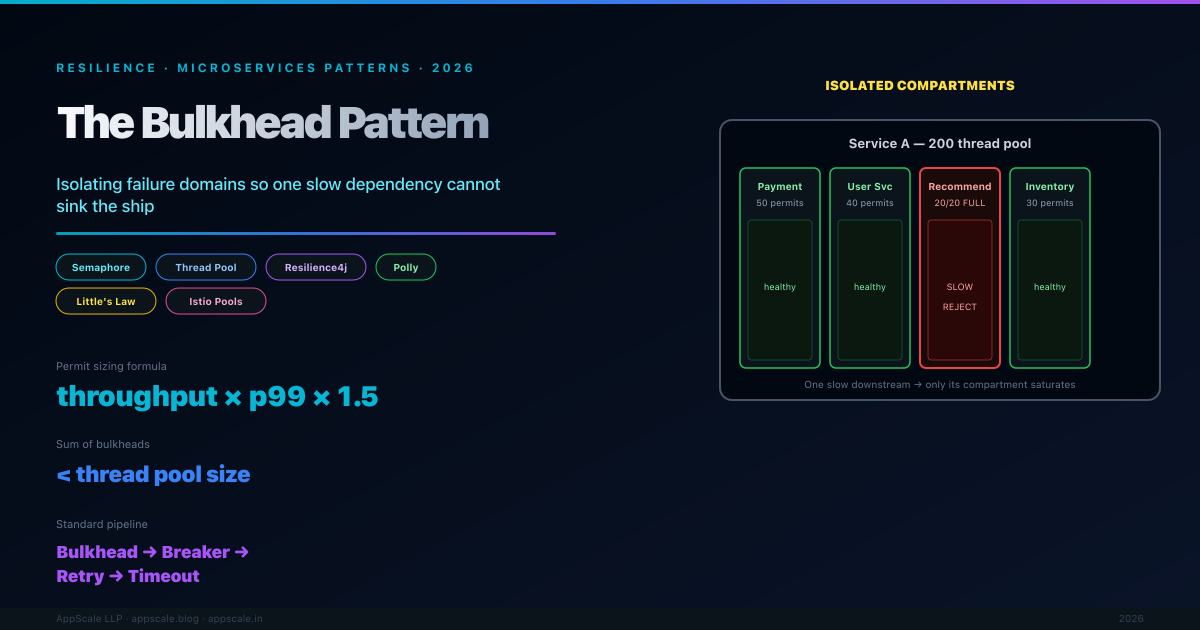
The Bulkhead Pattern: Isolating Failure Domains So One Slow Dependency Cannot Sink the Ship (2026)


The conventional circuit breaker was designed for a world where one service called one downstream and the failure modes were mostly availability — the dependency was up or down. AI agents inhabit a different world: an orchestrator that fans out to a heterogeneous set of tools, multiple LLM providers, and internal capabilities, each with its own failure profile, latency distribution, cost per call, and consequence on the agent's task. A single per-host breaker treats them all the same and is wrong almost everywhere. The agent-level circuit breaker pattern replaces the conventional one with a hierarchy of breakers — per-tool, per-provider, per-capability — each tuned to the failure mode it is meant to protect against. This article walks through the hierarchy in production: which dimensions need their own breakers, how thresholds should differ, what fallback semantics make sense at each layer, how to compose breakers with retries and timeouts without amplifying load, and the operational dashboards that make agent-level breakers debuggable.
Real microservices architectures contain SOAP services that nobody dares rewrite, partner integrations in protocols nobody picks anymore, and external APIs whose payload shapes resemble nothing the internal domain model uses. The adapter pattern places dedicated translation components between systems that need to talk but speak incompatible protocols, formats, or semantics. This guide covers the canonical use cases (legacy bridging, schema translation, vendor abstraction), the variants (inbound, outbound, anti-corruption layer), production implementation patterns including a worked Stripe webhook adapter, and the failure modes that turn adapters from useful seams into the most fragile parts of the system.
The API gateway is the most consequential infrastructure decision in a microservices architecture and the one most consistently underestimated. This guide covers what concerns belong in the gateway and what does not, the architectural variants (edge gateway, mesh gateway, BFF), production configuration patterns for Kong / AWS API Gateway / Envoy / Traefik, the failure modes that turn a gateway from an asset into a single point of failure, and the role of the gateway in modern AI and LLM architectures.
Network retries, message re-delivery, and client timeouts mean write operations in distributed systems can be triggered more than once. Without idempotency, the result is duplicate charges, double inventory deductions, and incorrect state. This article covers the idempotency key pattern, Redis-based key stores with atomic SET NX, database unique constraints as the second line of defence, message queue deduplication, HTTP method semantics, and how idempotency integrates with Saga and Outbox patterns.
Advertise and partner
Reach engineering leaders and CTOs reading about AI, mobile and cloud architecture.
Sponsored mentions and co-authored articles or technical deep-dives. Relevant products only, always disclosed.