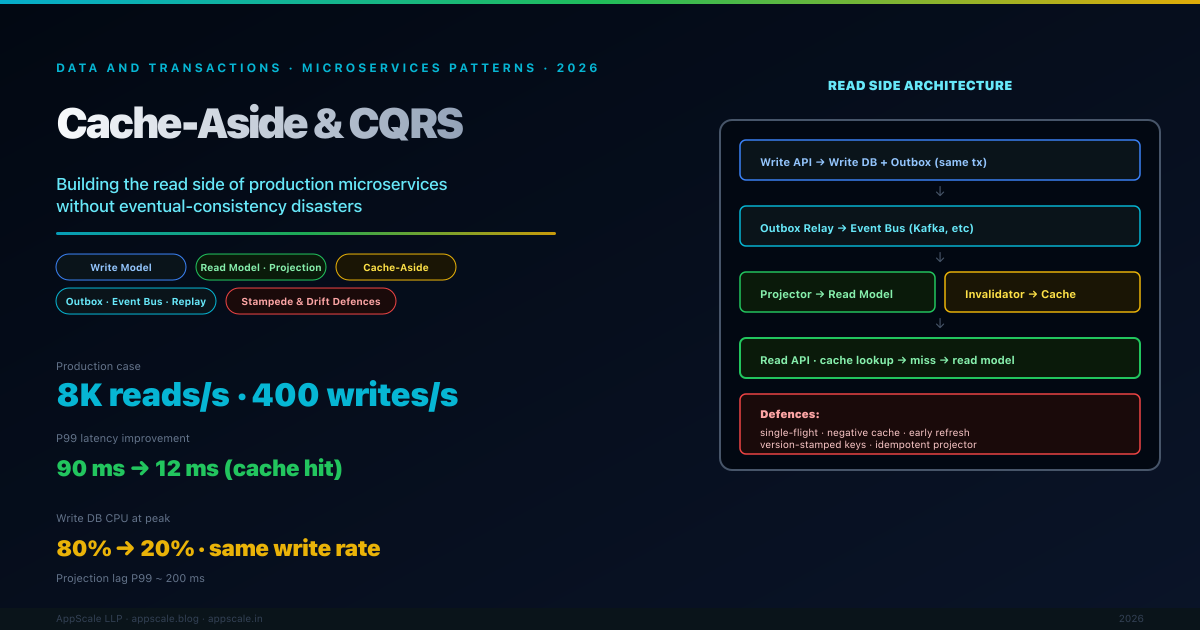
The Cache-Aside and CQRS Pattern: Building the Read Side of Production Microservices Without Eventual-Consistency Disasters (2026)


The API gateway is the most consequential infrastructure decision in a microservices architecture and the one most consistently underestimated. This guide covers what concerns belong in the gateway and what does not, the architectural variants (edge gateway, mesh gateway, BFF), production configuration patterns for Kong / AWS API Gateway / Envoy / Traefik, the failure modes that turn a gateway from an asset into a single point of failure, and the role of the gateway in modern AI and LLM architectures.
The dual-write problem — writing to a database and publishing to a message broker without atomicity — causes data loss and phantom events in production. The Outbox pattern solves it definitively: write both the business record and the outbound message in the same database transaction, then relay it to the broker. This guide covers polling vs CDC relays, Debezium integration, consumer idempotency, and how Outbox enables reliable Saga step execution.
Two-phase commit breaks at scale. The Saga Orchestration pattern manages distributed transactions across microservices using a sequence of local transactions and compensating operations — no cross-service locks, no cascading failures. This guide covers orchestration vs choreography, compensating transaction design, Temporal vs database-backed orchestrators, and the Outbox pattern that makes it all reliable.
A production-grade deep-dive into the sidecar pattern — covering Kubernetes, ECS, and VM deployment models, Envoy and Fluent Bit resource sizing, service mesh trade-offs (Istio vs Dapr), graceful shutdown ordering, and the real cost of 200 pods of sidecars.
Advertise and partner
Reach engineering leaders and CTOs reading about AI, mobile and cloud architecture.
Sponsored mentions and co-authored articles or technical deep-dives. Relevant products only, always disclosed.