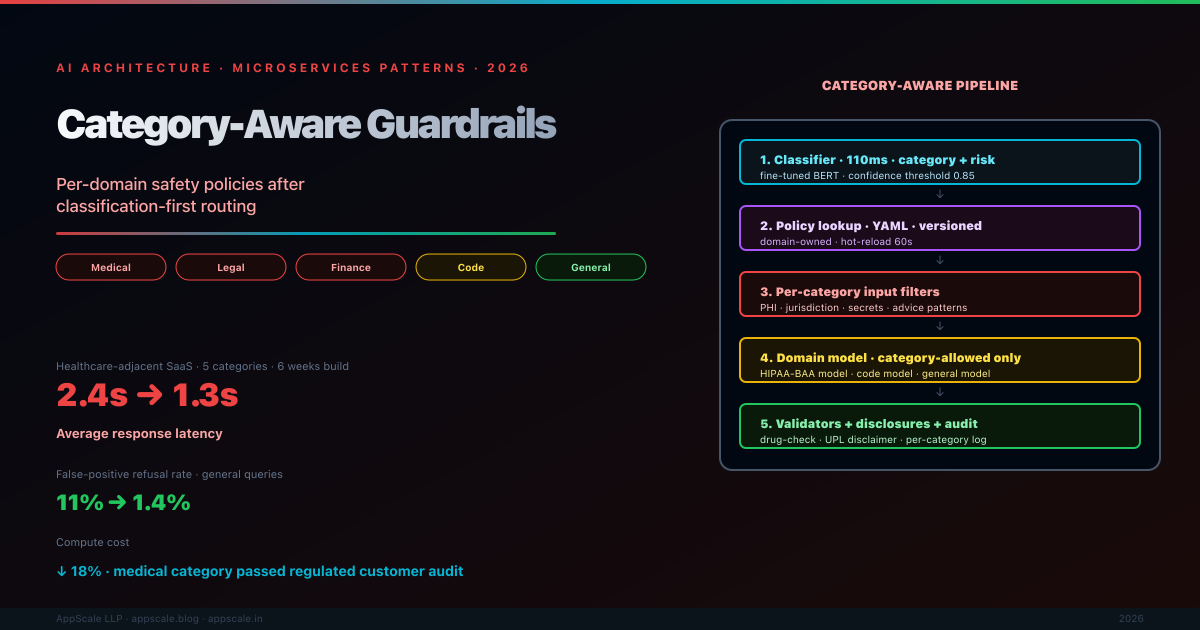
The single biggest mistake in production AI safety is treating the guardrail layer as a global, category-blind filter. Run medical, legal, finance, code, and general queries through one global guardrail and you get the worst of both worlds: under-protected high-risk categories, over-restricted general traffic, and a guardrail layer that fails compliance audit. Category-aware guardrails fix this by treating safety as a per-domain policy executed after the classification-first router has decided which category a request belongs to. This article covers the pattern in detail: structuring per-category policies (medical, legal, finance, code, general), integration with the classification-first router, the production case study showing 2.4s → 1.3s latency and 11% → 1.4% false-positive reduction, the anti-patterns that defeat the pattern, and the configuration values that work at scale.