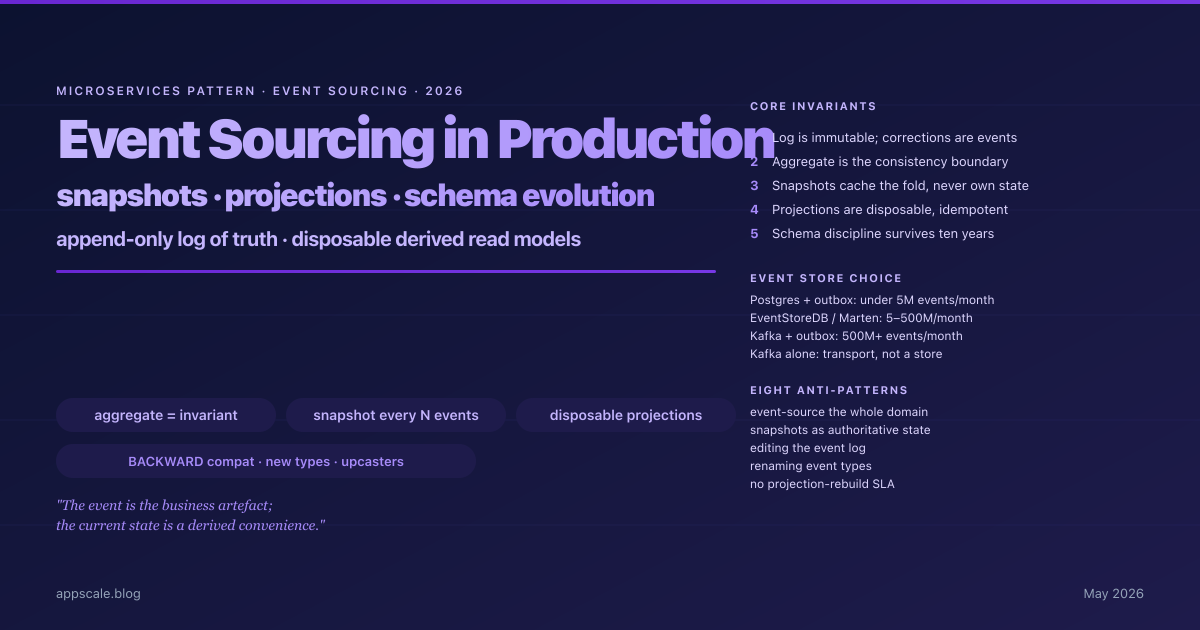
Event Sourcing in Production — Snapshots, Projections, and Schema Evolution Without Tears (2026)


Backend-for-Frontend in 2026: one BFF per client experience, GraphQL Federation vs tRPC vs REST per client-shape, Edge BFFs, and eight production anti-patterns.
The 2026 architecture for database-per-service plus cross-service joins via Debezium CDC, Kafka, and ksqlDB / Flink materialised views — with the operational runbook.
Synchronous request-reply is the easy default. It also breaks at exactly the moment the system starts to matter — slow downstream services, deployment coordination across teams, back-pressure cascades that turn local hot spots into system-wide outages. Event-driven architecture replaces the implicit call graph with an explicit event log: producers publish facts, consumers subscribe and react in their own time, and the contract is a versioned schema in a registry. This article is the broker-and-contract perspective on event-driven architecture: choosing between Kafka, SNS+SQS, NATS, EventBridge, and Pulsar; schema registry discipline and contract evolution; idempotent consumers and at-least-once delivery; ordered partitioning and throughput; dead-letter queues; production configuration values; and the anti-patterns that defeat the pattern.
The Saga and Outbox patterns are most often essential when combined. This article is the production recipe for combining them: the five invariants you must preserve, the schemas, the state machine, six failure modes the combination survives, common implementation mistakes, observability, and an incremental migration path from a synchronous chained-call implementation. With four Mermaid diagrams, full SQL schemas, and a 30-question FAQ.
Advertise and partner
Reach engineering leaders and CTOs reading about AI, mobile and cloud architecture.
Sponsored mentions and co-authored articles or technical deep-dives. Relevant products only, always disclosed.