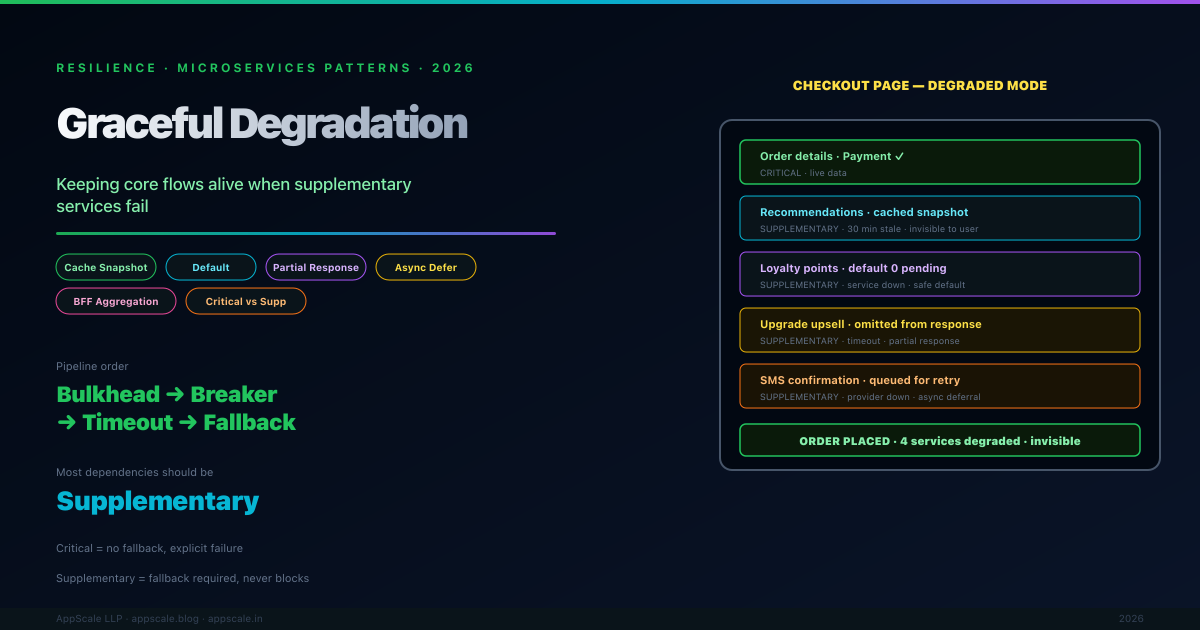
The Graceful Degradation Pattern: Keeping Core Flows Alive When Supplementary Services Fail (2026)


Real microservices architectures contain SOAP services that nobody dares rewrite, partner integrations in protocols nobody picks anymore, and external APIs whose payload shapes resemble nothing the internal domain model uses. The adapter pattern places dedicated translation components between systems that need to talk but speak incompatible protocols, formats, or semantics. This guide covers the canonical use cases (legacy bridging, schema translation, vendor abstraction), the variants (inbound, outbound, anti-corruption layer), production implementation patterns including a worked Stripe webhook adapter, and the failure modes that turn adapters from useful seams into the most fragile parts of the system.
The API gateway is the most consequential infrastructure decision in a microservices architecture and the one most consistently underestimated. This guide covers what concerns belong in the gateway and what does not, the architectural variants (edge gateway, mesh gateway, BFF), production configuration patterns for Kong / AWS API Gateway / Envoy / Traefik, the failure modes that turn a gateway from an asset into a single point of failure, and the role of the gateway in modern AI and LLM architectures.
Network retries, message re-delivery, and client timeouts mean write operations in distributed systems can be triggered more than once. Without idempotency, the result is duplicate charges, double inventory deductions, and incorrect state. This article covers the idempotency key pattern, Redis-based key stores with atomic SET NX, database unique constraints as the second line of defence, message queue deduplication, HTTP method semantics, and how idempotency integrates with Saga and Outbox patterns.
The dual-write problem — writing to a database and publishing to a message broker without atomicity — causes data loss and phantom events in production. The Outbox pattern solves it definitively: write both the business record and the outbound message in the same database transaction, then relay it to the broker. This guide covers polling vs CDC relays, Debezium integration, consumer idempotency, and how Outbox enables reliable Saga step execution.
Advertise and partner
Reach engineering leaders and CTOs reading about AI, mobile and cloud architecture.
Sponsored mentions and co-authored articles or technical deep-dives. Relevant products only, always disclosed.