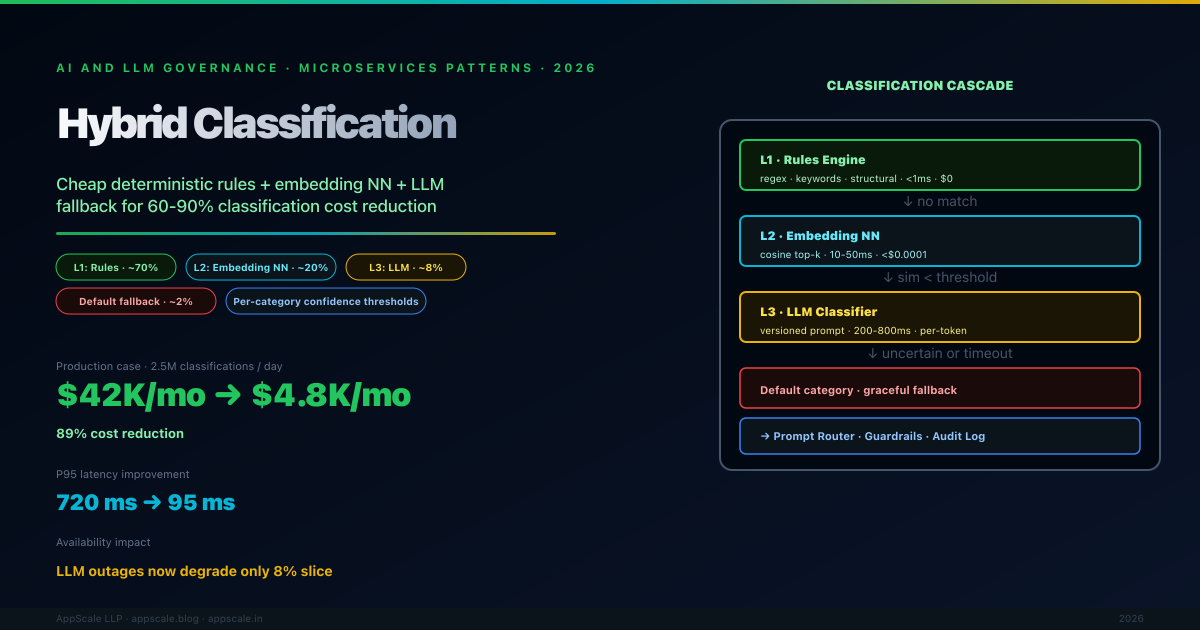
The Hybrid Classification Pattern: Combining Cheap Deterministic Classifiers With LLM Fallback for 60-90% Cost Reduction (2026)


The first instinct when wiring observability into an LLM system is to treat the LLM call as just another HTTP outbound call. Within a week the team realises conventional observability is missing everything that matters — the span tells you the call took 4.2 seconds and returned 200 OK but does not tell you token counts, cost in dollars, model variant, prompt template version, eval scores, tool calls, or whether the response was a hallucination versus a useful answer. Conventional observability tells you the system is up; AI observability needs to tell you whether the system is producing useful output at acceptable cost. This article covers the OpenTelemetry GenAI semantic conventions stabilising in late 2025/early 2026, what to instrument and how, the agent trace hierarchy that makes multi-step debugging tractable, how to attribute token cost across a multi-tenant deployment, how to surface eval scores as first-class telemetry, and the dashboards every production AI team should have on day one.
The OpenAI outage of December 2024 and the Anthropic capacity event of March 2025 took every dependent application offline. The multi-provider fallback pattern addresses this directly: pre-validate alternative providers, automate health-check-based switching, and ensure the application continues to function when any single provider goes down. This article covers multi-provider architecture for LLMs, payments, SMS, and cloud services; how to handle schema and behaviour differences; cost and quality trade-offs; the failure-detection logic that triggers switching; the failure modes the pattern itself can introduce; and the operational discipline of keeping the secondary path actually working when needed.
The static model choice has become the most expensive architectural decision in a 2026 LLM system. The provider market now spans a 60-200x price spread end to end, the quality gap on the dominant production workload is below the noise floor of A/B telemetry, and the latency profile of frontier models has widened — not narrowed. The Model Router Pattern is the architectural answer: a routing layer that, for every inbound request, chooses the cheapest model on the provider mix whose expected quality and latency clear the workload-specific gate, with a deterministic fallback when the routing decision turns out wrong. This article specifies the three routing axes (cost, quality, latency) and why single-axis routing always degrades, the four router primitives (cascade, classifier, learned, embedding-similarity) and when each is right, the 2026 landscape (Martian, NotDiamond, RouteLLM, Bedrock Intelligent Prompt Routing, OpenRouter Auto, Portkey, LiteLLM), the four-component calibration loop, the cost math with worked per-million-token economics, eight anti-patterns, and the five-stage maturity ladder from "we picked GPT" to a router that contributes a measurable line item to gross margin.
The single biggest mistake in production AI safety is treating the guardrail layer as a global, category-blind filter. Run medical, legal, finance, code, and general queries through one global guardrail and you get the worst of both worlds: under-protected high-risk categories, over-restricted general traffic, and a guardrail layer that fails compliance audit. Category-aware guardrails fix this by treating safety as a per-domain policy executed after the classification-first router has decided which category a request belongs to. This article covers the pattern in detail: structuring per-category policies (medical, legal, finance, code, general), integration with the classification-first router, the production case study showing 2.4s → 1.3s latency and 11% → 1.4% false-positive reduction, the anti-patterns that defeat the pattern, and the configuration values that work at scale.
Advertise and partner
Reach engineering leaders and CTOs reading about AI, mobile and cloud architecture.
Sponsored mentions and co-authored articles or technical deep-dives. Relevant products only, always disclosed.