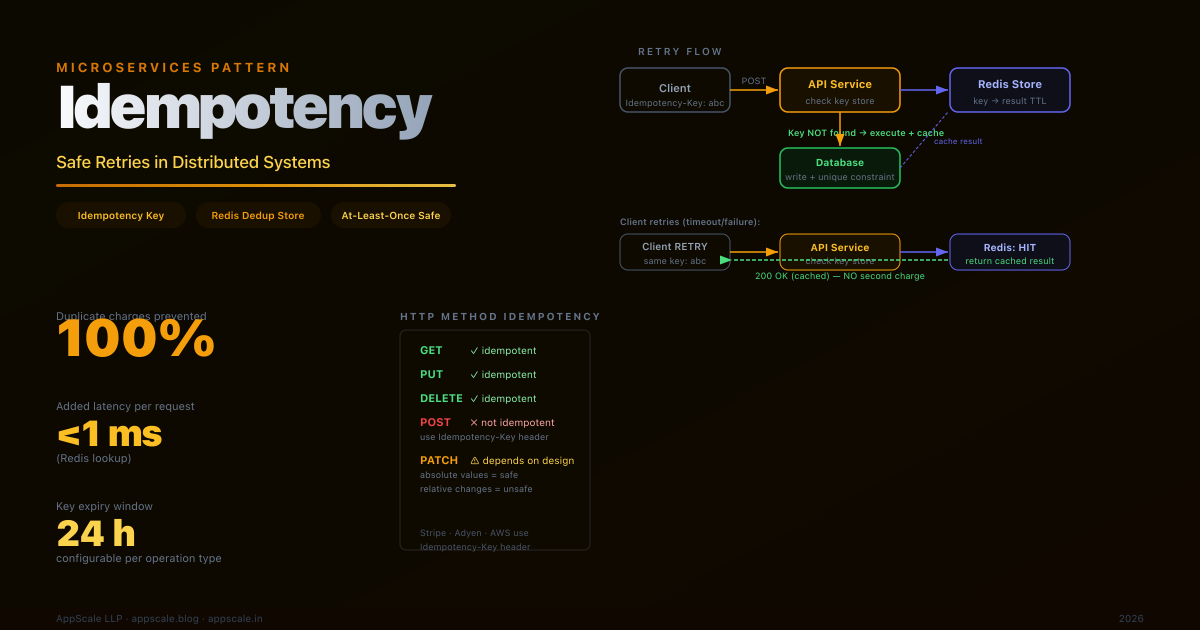
Idempotency in Distributed Systems: Safe Retries, Deduplication, and the Idempotency Key Pattern (2026)


Two-phase commit breaks at scale. The Saga Orchestration pattern manages distributed transactions across microservices using a sequence of local transactions and compensating operations — no cross-service locks, no cascading failures. This guide covers orchestration vs choreography, compensating transaction design, Temporal vs database-backed orchestrators, and the Outbox pattern that makes it all reliable.
The single biggest performance lever for a globally-distributed system is reducing the network distance between users and the data they read. Multi-region read replication maintains read-only replicas in each region where users live, with writes flowing to a primary and reads served from the geographically nearest replica. This guide covers when the pattern is the right answer, the read-after-write consistency strategies that determine whether the application can tolerate replication lag, the database technologies (Postgres logical replication, Aurora Global, DynamoDB Global Tables, CockroachDB, Spanner), production configuration with Postgres, and the operational discipline that prevents subtle consistency bugs.
Most microservices outages do not trace back to exotic edge cases — they trace back to four infrastructure anti-patterns that the team knew about in principle but had not engineered against in practice. Synchronous blocking calls turn one slow downstream into a complete platform freeze. Missing idempotency turns a network blip into duplicate charges and ghost orders. Tightly coupled services turn the independent-deployment promise into a distributed monolith. Centralised retry logic turns a brief degradation into a stampede that prevents recovery. This article walks through all four with credible failure stories, architectural diagnoses, fix patterns with cross-links to the positive constructions, the unwinding order that works in production, detection signatures that catch the anti-patterns early, and configuration values that work at scale.
The pick-two triangle is a misunderstanding: partitions happen regardless. PACELC, quorum arithmetic, and what DynamoDB, Spanner, and Postgres actually choose.
Advertise and partner
Reach engineering leaders and CTOs reading about AI, mobile and cloud architecture.
Sponsored mentions and co-authored articles or technical deep-dives. Relevant products only, always disclosed.