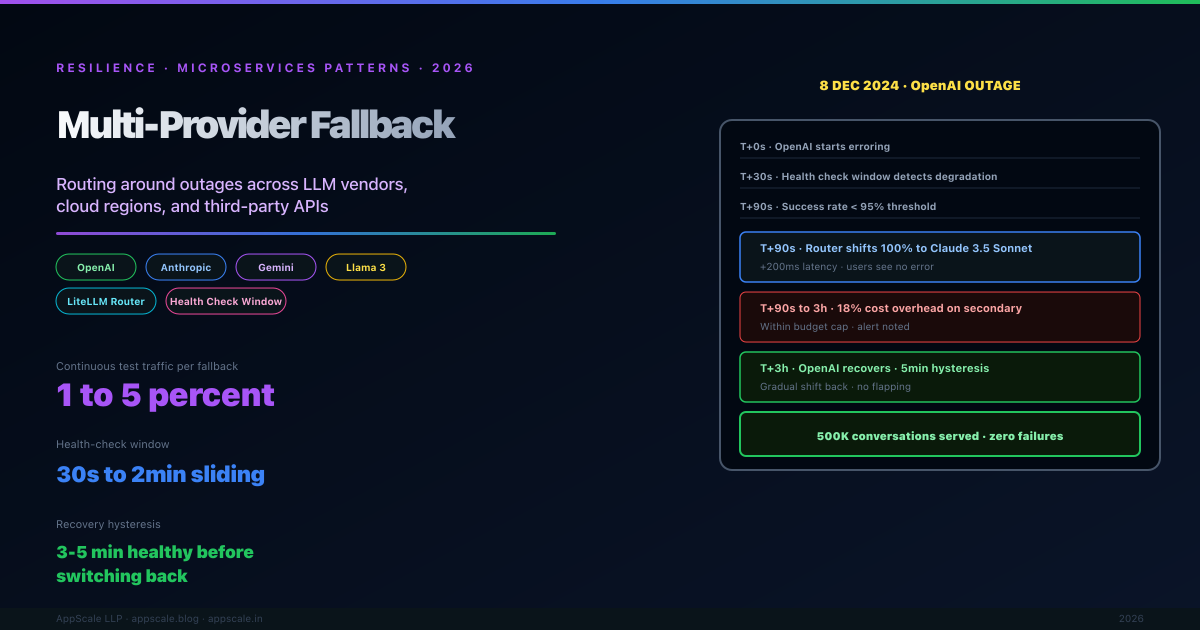
The Multi-Provider Fallback Pattern: Routing Around Outages Across LLM Vendors, Cloud Regions, and Third-Party APIs (2026)


An enterprise spent nine months duplicating its AI stack across two clouds; every real incident was a quota ceiling. Multi-provider routing: the architecture that pays.
The classifier sits at the entrance to every well-designed AI system. The obvious implementation is to use an LLM. It works on day one. By month three, the team is paying tens of thousands per month for classification, watching tail latency drift upwards, and absorbing classifier outages every time the model provider has an incident. The hybrid classification pattern fixes this with a tiered pipeline: cheap deterministic rules handle 60-80% of traffic at near-zero cost; an embedding nearest-neighbour classifier handles 10-25% at sub-cent cost; the LLM handles only the genuinely ambiguous 5-15%. The economic effect is a 60-90% cost reduction; the architectural effect is more important — the system stops paying frontier-model latency for trivial decisions and the failure surface narrows. This article covers the three-layer pipeline, confidence-threshold tuning per category, training-data sourcing, fallback ordering, composition with Classification-First and Prompt Routing, anti-patterns, and configuration values.
The static model choice has become the most expensive architectural decision in a 2026 LLM system. The provider market now spans a 60-200x price spread end to end, the quality gap on the dominant production workload is below the noise floor of A/B telemetry, and the latency profile of frontier models has widened — not narrowed. The Model Router Pattern is the architectural answer: a routing layer that, for every inbound request, chooses the cheapest model on the provider mix whose expected quality and latency clear the workload-specific gate, with a deterministic fallback when the routing decision turns out wrong. This article specifies the three routing axes (cost, quality, latency) and why single-axis routing always degrades, the four router primitives (cascade, classifier, learned, embedding-similarity) and when each is right, the 2026 landscape (Martian, NotDiamond, RouteLLM, Bedrock Intelligent Prompt Routing, OpenRouter Auto, Portkey, LiteLLM), the four-component calibration loop, the cost math with worked per-million-token economics, eight anti-patterns, and the five-stage maturity ladder from "we picked GPT" to a router that contributes a measurable line item to gross margin.
The single biggest performance lever for a globally-distributed system is reducing the network distance between users and the data they read. Multi-region read replication maintains read-only replicas in each region where users live, with writes flowing to a primary and reads served from the geographically nearest replica. This guide covers when the pattern is the right answer, the read-after-write consistency strategies that determine whether the application can tolerate replication lag, the database technologies (Postgres logical replication, Aurora Global, DynamoDB Global Tables, CockroachDB, Spanner), production configuration with Postgres, and the operational discipline that prevents subtle consistency bugs.
Advertise and partner
Reach engineering leaders and CTOs reading about AI, mobile and cloud architecture.
Sponsored mentions and co-authored articles or technical deep-dives. Relevant products only, always disclosed.