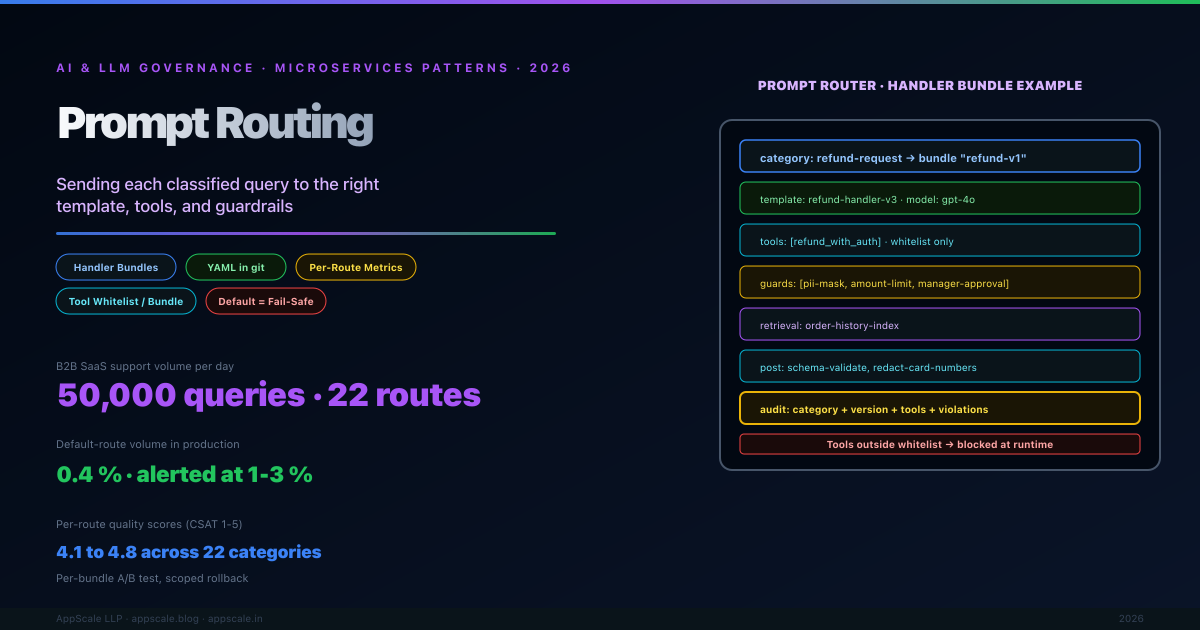
The Prompt Routing Pattern: Sending Each Classified Query to the Right Template, Tools, and Guardrails (2026)


The single biggest mistake in production AI safety is treating the guardrail layer as a global, category-blind filter. Run medical, legal, finance, code, and general queries through one global guardrail and you get the worst of both worlds: under-protected high-risk categories, over-restricted general traffic, and a guardrail layer that fails compliance audit. Category-aware guardrails fix this by treating safety as a per-domain policy executed after the classification-first router has decided which category a request belongs to. This article covers the pattern in detail: structuring per-category policies (medical, legal, finance, code, general), integration with the classification-first router, the production case study showing 2.4s → 1.3s latency and 11% → 1.4% false-positive reduction, the anti-patterns that defeat the pattern, and the configuration values that work at scale.
The most common mistake in production AI systems is to treat the model as the final decision-maker for every input. The model is a probabilistic component — sometimes confident and correct, sometimes confident and wrong, sometimes uncertain and the right answer is "ask a human." A system that ignores the third case ships hallucinations as authoritative answers; a system that routes everything through humans defeats the point of automation. The Human-in-the-Loop escalation pattern is a structured routing mechanism that detects, before the prediction is acted upon, that the model's output should not be trusted, and routes that input to a human reviewer with the right context to decide. The reviewer's decision becomes both the immediate user-facing answer and a labelled training example that closes the feedback loop. This article covers the production design: which signals reliably indicate "this needs a human" (calibrated confidence, novelty, policy triggers, contradiction), how to build a reviewer queue that humans can keep up with, what the interface needs for sub-30-second decisions, and how to feed reviewer decisions back into training without contamination.
The most consequential string in any production AI system is the prompt template. It controls behaviour, tone, safety, accuracy, cost, and latency. A small change can move quality up or down by ten per cent; a thoughtless edit can introduce regressions that take weeks to detect. Yet in the early demo era, prompts were typically pasted into application code as multi-line string literals, edited directly, with no review, no version history, no rollback story. The versioned prompt templates pattern fixes this by treating prompts as first-class system assets — stored in a versioned repository, referenced by explicit version IDs, deployed through review-and-rollout discipline, logged in the audit trail. This article covers immutability of published versions, implementation patterns (file-based, database-backed, managed platforms, hybrid), composition with classification-first and prompt routing, anti-patterns, configuration values, and the operational discipline of A/B testing and quality-gated promotion.
Most AI system failures in production are not novel; they are repeat performances of a small number of well-known anti-patterns that teams keep rediscovering because the lessons are scattered across post-mortems that never get aggregated. This article bundles four of the most damaging into one reference: the unclassified query (treating every input as one category routed through one flow), the generic single-prompt (one giant 4-8k token system prompt covering every behaviour), monolithic safety (one configuration applied to every category and tenant regardless of differing requirements), and confident misclassification (the model is wrong but expresses high confidence so the system acts on the wrong answer). Each looks reasonable when small; each becomes a load-bearing failure mode as the system grows; each has a structural fix described in the dedicated positive patterns elsewhere in this series. The four share a structural theme — undifferentiated handling of inputs that have meaningfully different requirements — and they compound: each makes fixing the others harder. This article documents the failure modes, the detection signatures, the unwinding order, and a production case study that improved every metric.
Advertise and partner
Reach engineering leaders and CTOs reading about AI, mobile and cloud architecture.
Sponsored mentions and co-authored articles or technical deep-dives. Relevant products only, always disclosed.