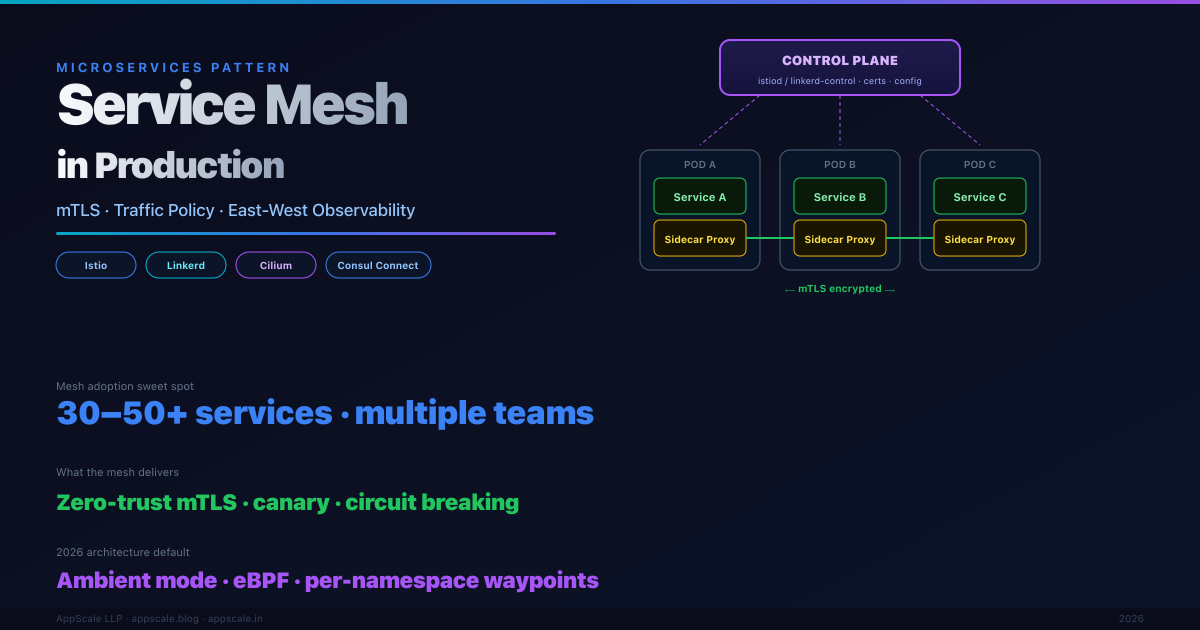
Service Mesh in Production: mTLS, Traffic Policy, and Observability (2026)


The first instinct when wiring observability into an LLM system is to treat the LLM call as just another HTTP outbound call. Within a week the team realises conventional observability is missing everything that matters — the span tells you the call took 4.2 seconds and returned 200 OK but does not tell you token counts, cost in dollars, model variant, prompt template version, eval scores, tool calls, or whether the response was a hallucination versus a useful answer. Conventional observability tells you the system is up; AI observability needs to tell you whether the system is producing useful output at acceptable cost. This article covers the OpenTelemetry GenAI semantic conventions stabilising in late 2025/early 2026, what to instrument and how, the agent trace hierarchy that makes multi-step debugging tractable, how to attribute token cost across a multi-tenant deployment, how to surface eval scores as first-class telemetry, and the dashboards every production AI team should have on day one.
The API gateway is the most consequential infrastructure decision in a microservices architecture and the one most consistently underestimated. This guide covers what concerns belong in the gateway and what does not, the architectural variants (edge gateway, mesh gateway, BFF), production configuration patterns for Kong / AWS API Gateway / Envoy / Traefik, the failure modes that turn a gateway from an asset into a single point of failure, and the role of the gateway in modern AI and LLM architectures.
A production-grade deep-dive into the sidecar pattern — covering Kubernetes, ECS, and VM deployment models, Envoy and Fluent Bit resource sizing, service mesh trade-offs (Istio vs Dapr), graceful shutdown ordering, and the real cost of 200 pods of sidecars.
Synchronous request-reply is the easy default. It also breaks at exactly the moment the system starts to matter — slow downstream services, deployment coordination across teams, back-pressure cascades that turn local hot spots into system-wide outages. Event-driven architecture replaces the implicit call graph with an explicit event log: producers publish facts, consumers subscribe and react in their own time, and the contract is a versioned schema in a registry. This article is the broker-and-contract perspective on event-driven architecture: choosing between Kafka, SNS+SQS, NATS, EventBridge, and Pulsar; schema registry discipline and contract evolution; idempotent consumers and at-least-once delivery; ordered partitioning and throughput; dead-letter queues; production configuration values; and the anti-patterns that defeat the pattern.
Advertise and partner
Reach engineering leaders and CTOs reading about AI, mobile and cloud architecture.
Sponsored mentions and co-authored articles or technical deep-dives. Relevant products only, always disclosed.