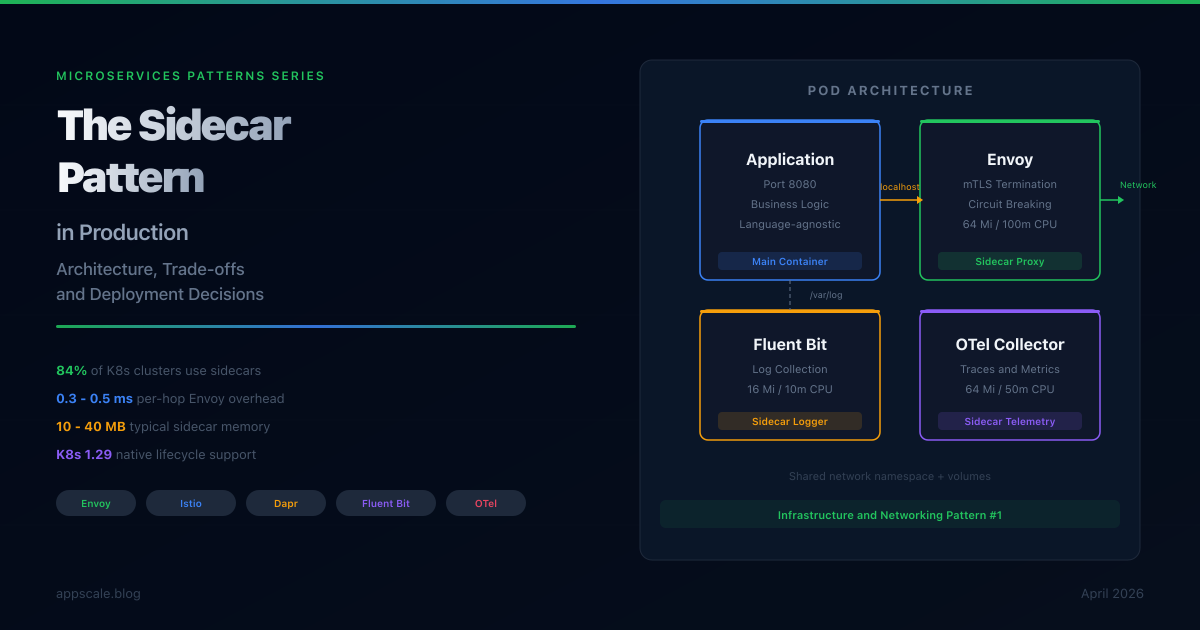
The Sidecar Pattern in Production: Architecture, Trade-offs, and Deployment Decisions (2026)


Synchronous request-reply is the easy default. It also breaks at exactly the moment the system starts to matter — slow downstream services, deployment coordination across teams, back-pressure cascades that turn local hot spots into system-wide outages. Event-driven architecture replaces the implicit call graph with an explicit event log: producers publish facts, consumers subscribe and react in their own time, and the contract is a versioned schema in a registry. This article is the broker-and-contract perspective on event-driven architecture: choosing between Kafka, SNS+SQS, NATS, EventBridge, and Pulsar; schema registry discipline and contract evolution; idempotent consumers and at-least-once delivery; ordered partitioning and throughput; dead-letter queues; production configuration values; and the anti-patterns that defeat the pattern.
A production-grade deep-dive into the ambassador pattern — covering outbound proxy architecture with Envoy, per-dependency retry policies, connection pooling, circuit breaking, protocol translation, and the decision framework for choosing between ambassadors, sidecars, and service meshes.
The API gateway is the most consequential infrastructure decision in a microservices architecture and the one most consistently underestimated. This guide covers what concerns belong in the gateway and what does not, the architectural variants (edge gateway, mesh gateway, BFF), production configuration patterns for Kong / AWS API Gateway / Envoy / Traefik, the failure modes that turn a gateway from an asset into a single point of failure, and the role of the gateway in modern AI and LLM architectures.
Multi-tenant data architecture is one of the highest-leverage decisions a SaaS team ever makes — and one of the most under-discussed. The choice between silo (database per tenant), bridge (schema per tenant), and pool (shared schema with tenant_id) determines unit economics, blast radius, compliance posture, noisy-neighbour behaviour, and the cost of every migration for the rest of the product's life. This article is the production design guide: trade-off matrix, Postgres RLS for defence in depth, envelope encryption with per-tenant KMS keys, GDPR right-to-erasure per model, per-tenant cost attribution, migration paths, and the day-one infrastructure that pays back at year three.
Advertise and partner
Reach engineering leaders and CTOs reading about AI, mobile and cloud architecture.
Sponsored mentions and co-authored articles or technical deep-dives. Relevant products only, always disclosed.