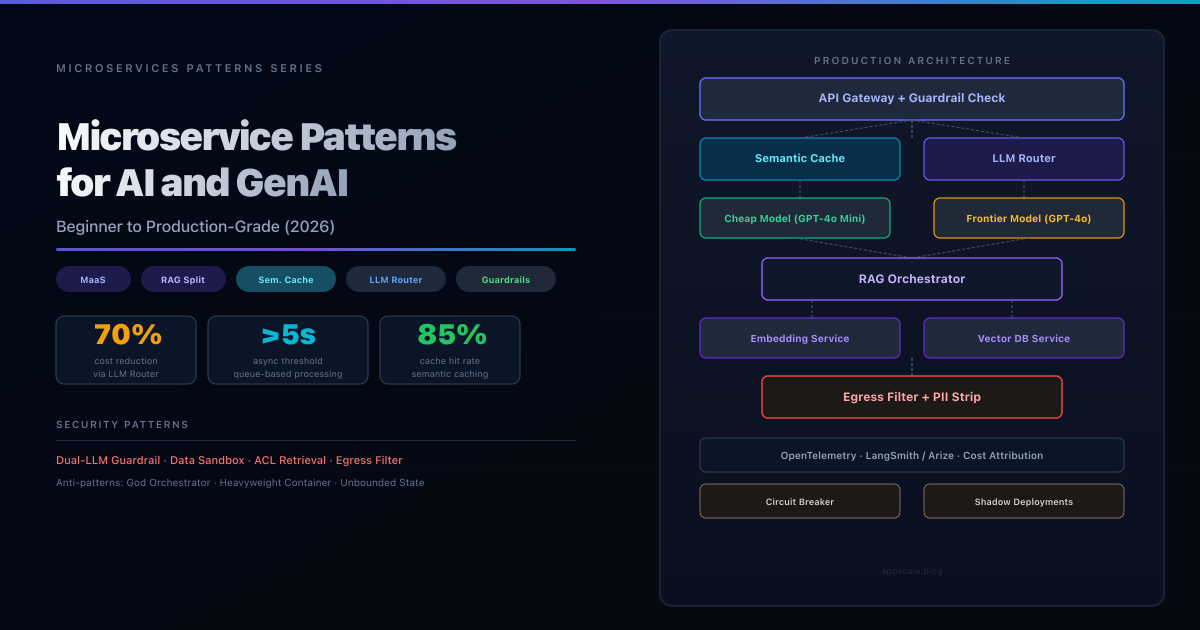
Microservices Patterns for AI and GenAI: From Beginner to Production-Grade (2026)


The single index to 50+ production AI architecture patterns — retrieval, agents, serving, evaluation, security, cost — with decision tables and anti-patterns.
The conventional circuit breaker was designed for a world where one service called one downstream and the failure modes were mostly availability — the dependency was up or down. AI agents inhabit a different world: an orchestrator that fans out to a heterogeneous set of tools, multiple LLM providers, and internal capabilities, each with its own failure profile, latency distribution, cost per call, and consequence on the agent's task. A single per-host breaker treats them all the same and is wrong almost everywhere. The agent-level circuit breaker pattern replaces the conventional one with a hierarchy of breakers — per-tool, per-provider, per-capability — each tuned to the failure mode it is meant to protect against. This article walks through the hierarchy in production: which dimensions need their own breakers, how thresholds should differ, what fallback semantics make sense at each layer, how to compose breakers with retries and timeouts without amplifying load, and the operational dashboards that make agent-level breakers debuggable.
The first instinct when wiring observability into an LLM system is to treat the LLM call as just another HTTP outbound call. Within a week the team realises conventional observability is missing everything that matters — the span tells you the call took 4.2 seconds and returned 200 OK but does not tell you token counts, cost in dollars, model variant, prompt template version, eval scores, tool calls, or whether the response was a hallucination versus a useful answer. Conventional observability tells you the system is up; AI observability needs to tell you whether the system is producing useful output at acceptable cost. This article covers the OpenTelemetry GenAI semantic conventions stabilising in late 2025/early 2026, what to instrument and how, the agent trace hierarchy that makes multi-step debugging tractable, how to attribute token cost across a multi-tenant deployment, how to surface eval scores as first-class telemetry, and the dashboards every production AI team should have on day one.
A production-grade reference for building AI agents on AWS Bedrock with a NestJS gateway in 2026 — Bedrock AgentCore, action groups backed by Lambda, knowledge bases over S3 + OpenSearch, the routing-and-guardrail layer that NestJS must own, the model-selection cost arithmetic, three-layer observability (gateway + agent-internal + per-token cost), Bedrock Guardrails plus app-specific PII redaction, multi-agent collaboration patterns, and the failure modes you only learn about by running this in production.
Advertise and partner
Reach engineering leaders and CTOs reading about AI, mobile and cloud architecture.
Sponsored mentions and co-authored articles or technical deep-dives. Relevant products only, always disclosed.