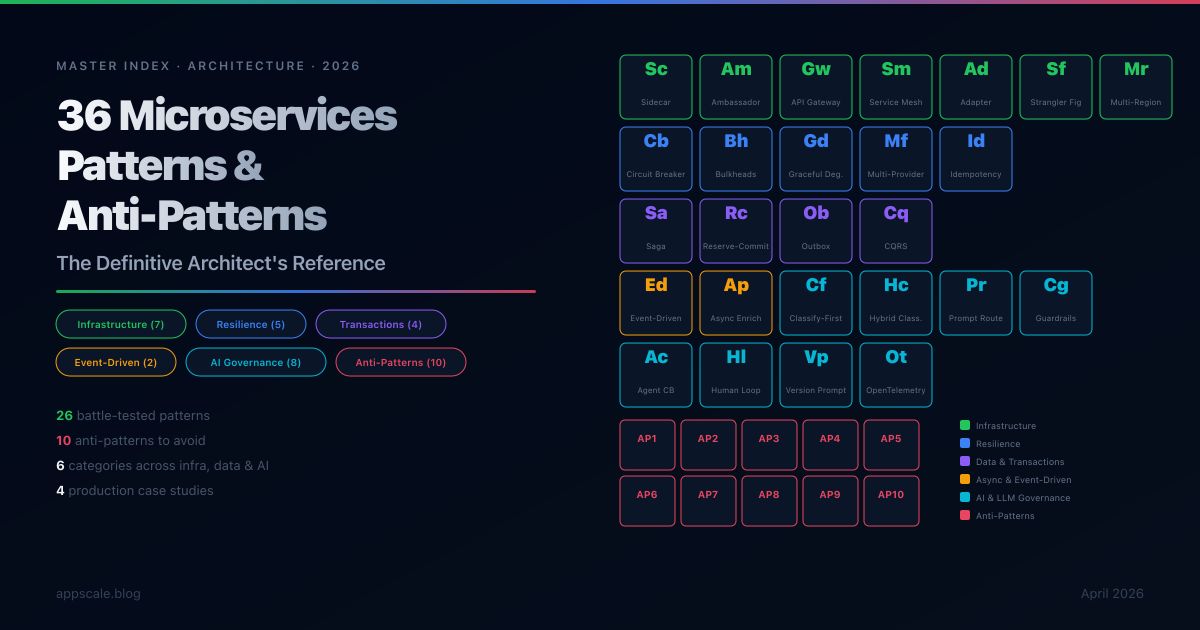
36 Microservices Patterns & Anti-Patterns: The Definitive Architect's Reference (2026)


Once a platform has more than a handful of services, orchestration becomes its own architectural concern. Two anti-patterns recur in every multi-service platform: synchronous blocking enrichment fans out to N downstream services in-line and waits for each, paying the sum of all latencies for every request and inheriting the product of all availabilities; centralised orchestration bottlenecks put every multi-step workflow through one shared orchestrator that becomes a single point of failure and a deployment chokepoint as the platform grows. Both share an underlying single-process mental model and both fail at scale. This article covers credible failure stories, architectural diagnoses, the fixes (parallel async enrichment and per-domain saga orchestration), the unwinding order that works in production, detection signatures including the latency-to-fan-out ratio, and configuration values from real platforms.
A comprehensive reference to 20+ microservices design patterns across decomposition, integration, infrastructure, database management, observability, deployment, resilience, and traffic management — with real-world use cases for each.
Most microservices outages do not trace back to exotic edge cases — they trace back to four infrastructure anti-patterns that the team knew about in principle but had not engineered against in practice. Synchronous blocking calls turn one slow downstream into a complete platform freeze. Missing idempotency turns a network blip into duplicate charges and ghost orders. Tightly coupled services turn the independent-deployment promise into a distributed monolith. Centralised retry logic turns a brief degradation into a stampede that prevents recovery. This article walks through all four with credible failure stories, architectural diagnoses, fix patterns with cross-links to the positive constructions, the unwinding order that works in production, detection signatures that catch the anti-patterns early, and configuration values that work at scale.
Choosing between synchronous, asynchronous, and event-driven AI architecture patterns is one of the most consequential decisions in production AI system design. This authoritative guide breaks down each pattern's production mechanics, GPU scheduling implications, cost tradeoffs, failure modes, and scaling strategies — with real architecture diagrams and hard-won engineering insights from systems built at scale.
Advertise and partner
Reach engineering leaders and CTOs reading about AI, mobile and cloud architecture.
Sponsored mentions and co-authored articles or technical deep-dives. Relevant products only, always disclosed.