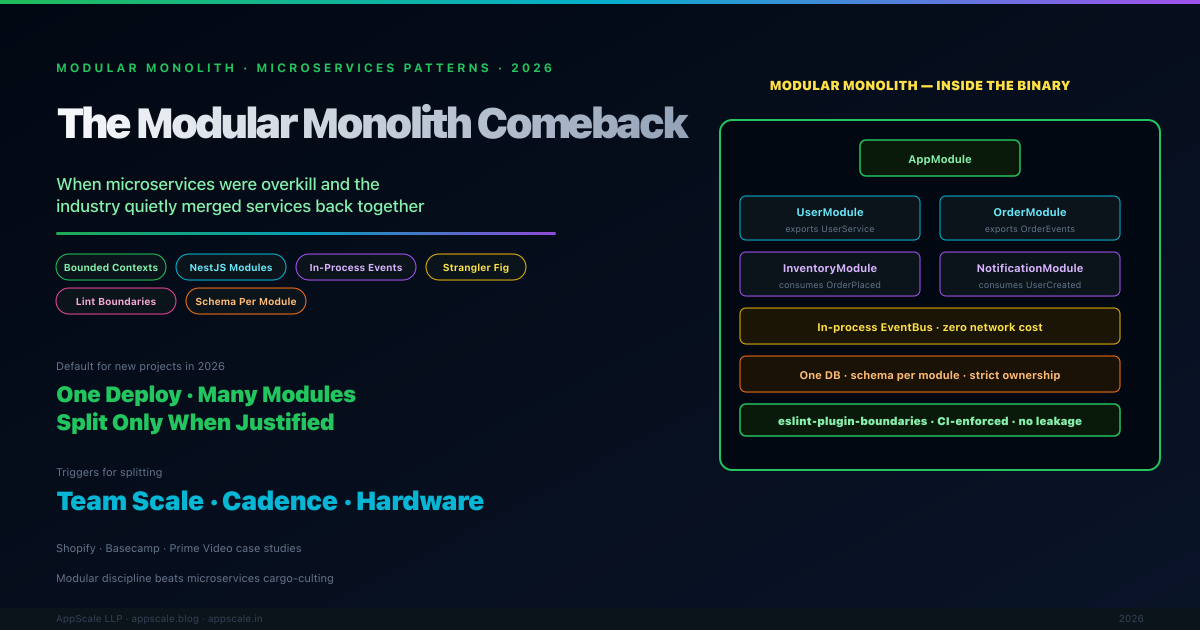
The Modular Monolith Comeback: When Microservices Were Overkill (2026)


The argument "Clean Architecture vs Vertical Slice Architecture" is a category error — the two operate on different axes. A module is a macro-architectural decision about bounded contexts, public contracts, data ownership and communication style. A vertical slice is a micro-architectural decision about feature folder organisation inside a module. The killer property of a real modular monolith is that the two axes are independent: heterogeneous internals (Clean Architecture in one module, vertical slices in another, transaction scripts in a third) live safely behind homogeneous module boundaries enforced by project references, ArchUnit rules, and schema grants. This article is the technical deep-dive: the five enforceable module properties, the four slice properties, the cross-module communication spectrum from in-process method calls to outbox-backed event buses, the per-module internal-style decision matrix, multi-layered boundary enforcement, eight anti-patterns, and the five-stage maturity ladder from layered monolith to deliberate modular-monolith target state.
The Saga and Outbox patterns are most often essential when combined. This article is the production recipe for combining them: the five invariants you must preserve, the schemas, the state machine, six failure modes the combination survives, common implementation mistakes, observability, and an incremental migration path from a synchronous chained-call implementation. With four Mermaid diagrams, full SQL schemas, and a 30-question FAQ.
Event sourcing for production microservices in 2026 — aggregate boundaries, append-only stores, snapshot strategy, projection rebuilds, and schema evolution.
Backend-for-Frontend in 2026: one BFF per client experience, GraphQL Federation vs tRPC vs REST per client-shape, Edge BFFs, and eight production anti-patterns.
Advertise and partner
Reach engineering leaders and CTOs reading about AI, mobile and cloud architecture.
Sponsored mentions and co-authored articles or technical deep-dives. Relevant products only, always disclosed.