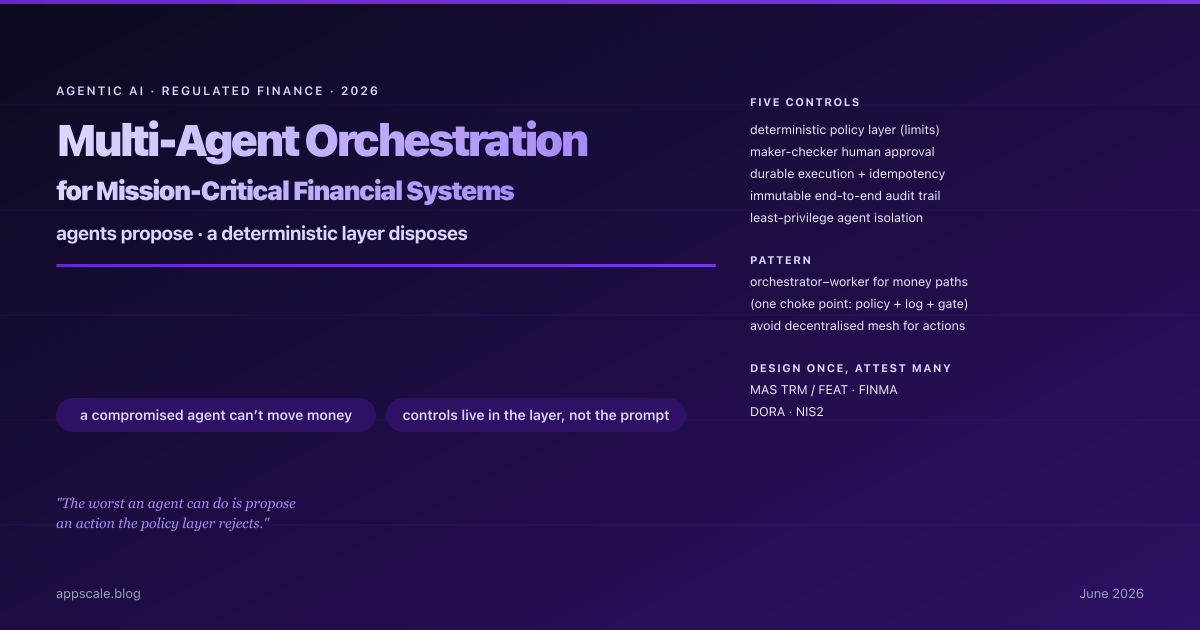
Architecting Multi-Agent Orchestration for Mission-Critical Financial Systems (2026)


The multi-agent demo dazzled; the system died before production. Only ~14% of pilots ship — the orchestration reliability layer, compounding-error math, and how to reach 99%.
How production SwarmAI platforms split into eight tiers, bound emergence with loop-breakers, route across model tiers, and cut costs by 90 percent without quality loss in 2026.
An agent mesh is what you end up with when you stop pretending one orchestrator can coordinate every autonomous capability in your enterprise. The orchestrator-as-central-brain works for ten agents, struggles at fifty, collapses at two hundred. The mesh is the alternative posture: agents discover each other through a registry, communicate through a message bus, negotiate work through coordinator-free patterns (gossip, role auctions, blackboards), and observe each other through trace propagation that survives asynchronous boundaries. This article covers the four topologies, the message bus options (NATS, Kafka, EventBridge), the coordinator-free coordination patterns, the role registry and capability discovery layer, observability across asynchronous agent boundaries, failure isolation through per-agent circuit breakers and dead-letter handling, and a reference implementation on NestJS plus AWS Bedrock with sequence diagrams.
An LLM is a poor recommender but a great reranking layer. The hybrid architecture: retrieval narrows millions of items, the LLM reasons over a shortlist.
Advertise and partner
Reach engineering leaders and CTOs reading about AI, mobile and cloud architecture.
Sponsored mentions and co-authored articles or technical deep-dives. Relevant products only, always disclosed.