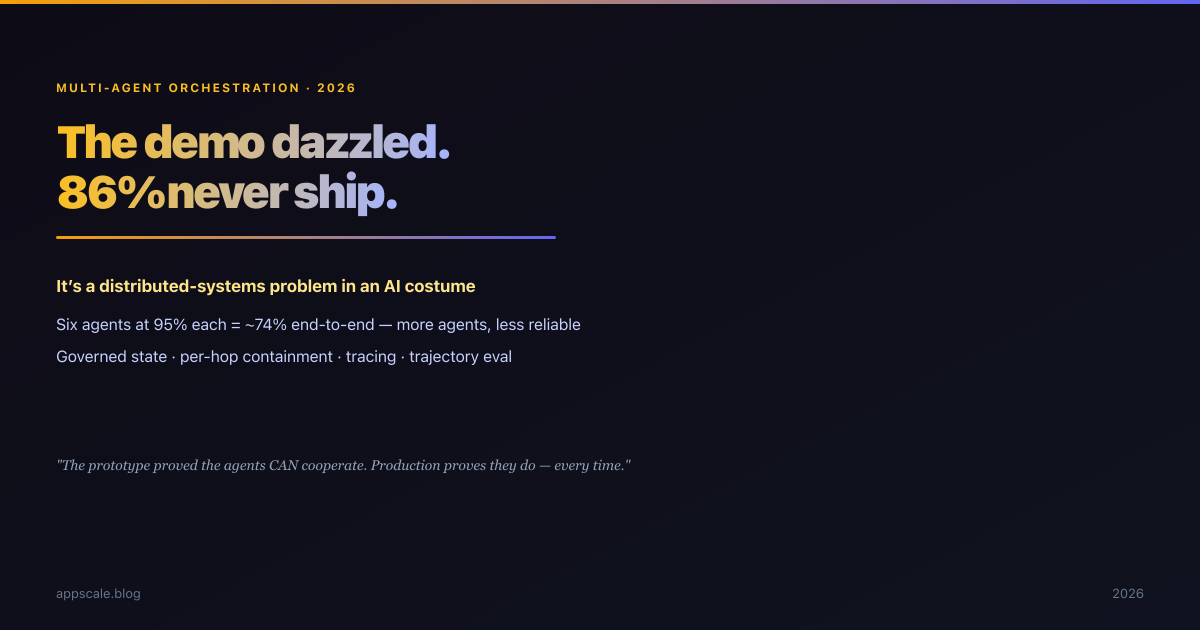
Why 86% of Multi-Agent Pilots Never Reach Production — and the Orchestration Architecture That Ships


The demo dazzled the board; six months later it still is not live. Why 62-70% of AI pilots die in the PoC-to-production gap, the five gaps, and the architecture that ships.
Architecting multi-agent AI for mission-critical finance: deterministic guardrails, maker-checker approval, durable execution, audit trails, and blast-radius isolation.
How production SwarmAI platforms split into eight tiers, bound emergence with loop-breakers, route across model tiers, and cut costs by 90 percent without quality loss in 2026.
An agent mesh is what you end up with when you stop pretending one orchestrator can coordinate every autonomous capability in your enterprise. The orchestrator-as-central-brain works for ten agents, struggles at fifty, collapses at two hundred. The mesh is the alternative posture: agents discover each other through a registry, communicate through a message bus, negotiate work through coordinator-free patterns (gossip, role auctions, blackboards), and observe each other through trace propagation that survives asynchronous boundaries. This article covers the four topologies, the message bus options (NATS, Kafka, EventBridge), the coordinator-free coordination patterns, the role registry and capability discovery layer, observability across asynchronous agent boundaries, failure isolation through per-agent circuit breakers and dead-letter handling, and a reference implementation on NestJS plus AWS Bedrock with sequence diagrams.
Advertise and partner
Reach engineering leaders and CTOs reading about AI, mobile and cloud architecture.
Sponsored mentions and co-authored articles or technical deep-dives. Relevant products only, always disclosed.