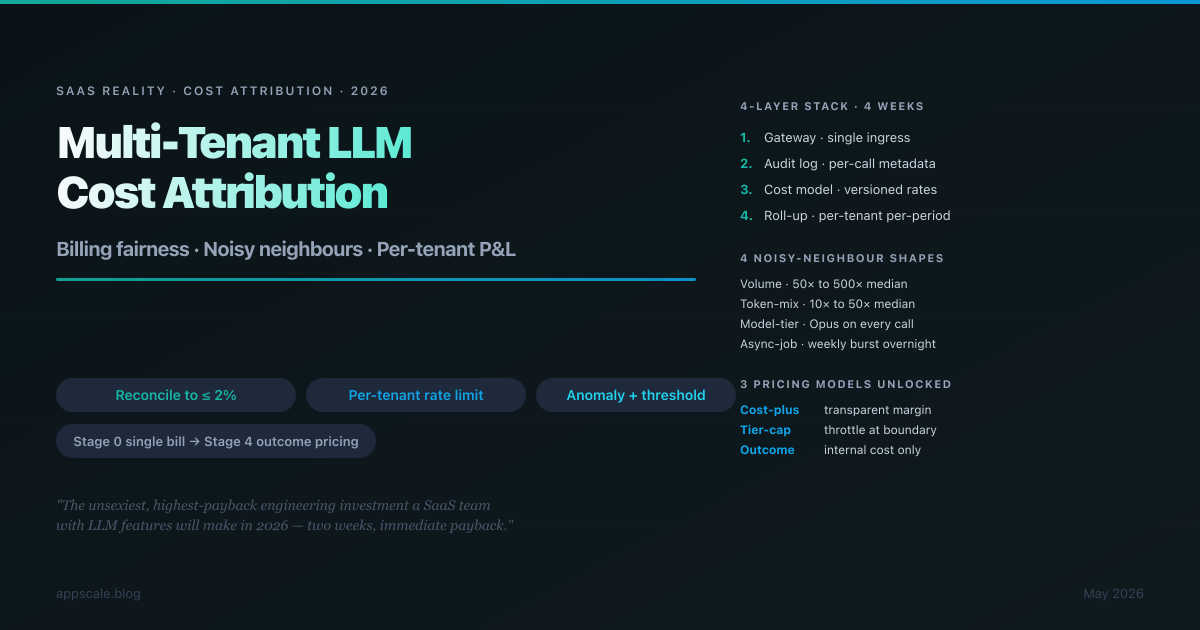
Multi-Tenant LLM Cost Attribution Architecture: Billing Fairness, Noisy Neighbours, and the Per-Tenant P&L (2026)


An enterprise spent nine months duplicating its AI stack across two clouds; every real incident was a quota ceiling. Multi-provider routing: the architecture that pays.
Agents and RAG apps re-send the same long prefix every turn. Prompt caching cuts input cost up to ~90% and speeds first tokens — the win most teams leave off.
Multi-tenant RAG has a security model that does not exist in single-tenant RAG and is not covered by generic SaaS multi-tenant discipline. The 2024–2025 incident record now has enough cross-tenant RAG leakage cases to classify the failure modes, and the result is a seven-vector taxonomy: cross-tenant retrieval leakage, embedding-space collisions, metadata-filter bypass, shared-index poisoning, re-ranker leakage, eval-set contamination, response-cache cross-talk. This article is the seven vectors with their mechanism and architectural defence, the per-tenant namespace pattern that closes them at every data surface, the eight anti-patterns that produce the bad outcomes, and the maturity ladder from Stage 0 (single shared everything) to Stage 4 (continuously-validated isolation).
A classification backfill through the chat endpoint turned a $400 job into $3,000 and still failed. Batch LLM inference: half the cost, resumable, built for finite jobs.
Advertise and partner
Reach engineering leaders and CTOs reading about AI, mobile and cloud architecture.
Sponsored mentions and co-authored articles or technical deep-dives. Relevant products only, always disclosed.