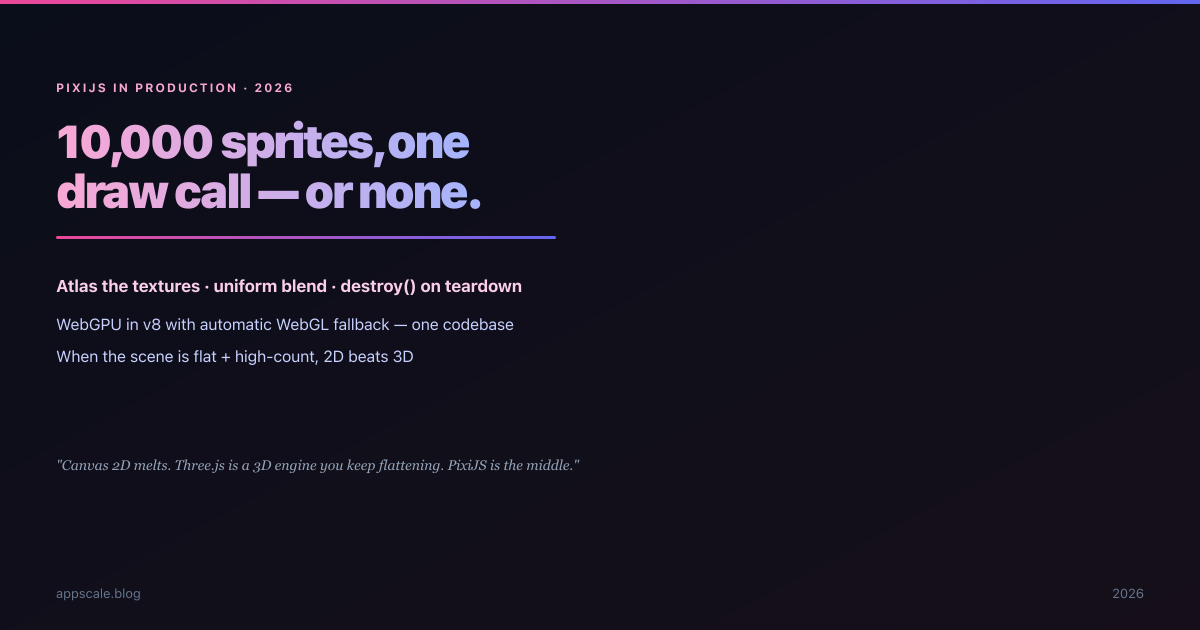
PixiJS in Production 2026: High-Performance 2D Web Graphics, WebGPU, and When 2D Beats 3D


The 3D prototype hit 120fps on the laptop and crawls on a real phone. Three.js in production 2026: draw calls, memory disposal, asset pipelines, and WebGPU with fallback.
WebGPU ships in major browsers: compute shaders and in-page AI inference, 10-15x on compute work. The production architecture — engine vs raw API, fallback ladders, in-page ML.
The default — pick the largest frontier model and route every request through it — is the wrong default for a meaningful share of production workloads in 2026. Small language models in the 2 to 14 billion parameter range (Phi-4, Llama 3.1 8B, Gemma 2, Mistral 7B, Qwen 2.5) handle classification, extraction, summarisation, and RAG re-ranking at one-fiftieth the cost per token of frontier models, with 5 to 10x lower latency. This guide covers the workloads where SLMs win, the model families and hardware to choose, the role of quantisation and fine-tuning, and the small-first routing pattern with frontier model fallback that most mature deployments converge on.
3D Gaussian Splatting became web infrastructure once delivery caught up: SPZ and SOG compression, WebGPU rendering, streamed LOD. The pipeline is the product — not the capture.
Advertise and partner
Reach engineering leaders and CTOs reading about AI, mobile and cloud architecture.
Sponsored mentions and co-authored articles or technical deep-dives. Relevant products only, always disclosed.