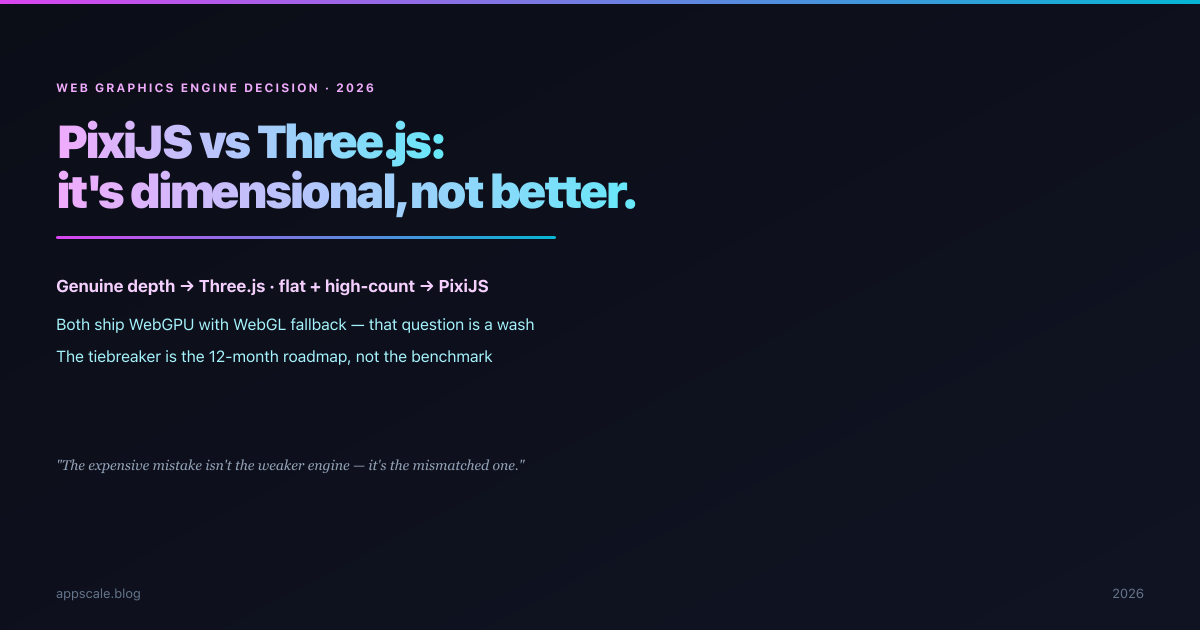
PixiJS vs Three.js in 2026: Choosing Your Web Graphics Engine Before It Chooses Your Roadmap


The 3D prototype hit 120fps on the laptop and crawls on a real phone. Three.js in production 2026: draw calls, memory disposal, asset pipelines, and WebGPU with fallback.
The 2D particle scene flew on the laptop and melts on a real phone. PixiJS in production 2026: sprite batching, texture atlases, memory disposal, and WebGPU with WebGL fallback.
Your team rewrote the same feature three times in four years. The innovation-budget framework for choosing technology that lasts — and spotting churn wearing a business case.
WebGPU ships in major browsers: compute shaders and in-page AI inference, 10-15x on compute work. The production architecture — engine vs raw API, fallback ladders, in-page ML.
Advertise and partner
Reach engineering leaders and CTOs reading about AI, mobile and cloud architecture.
Sponsored mentions and co-authored articles or technical deep-dives. Relevant products only, always disclosed.