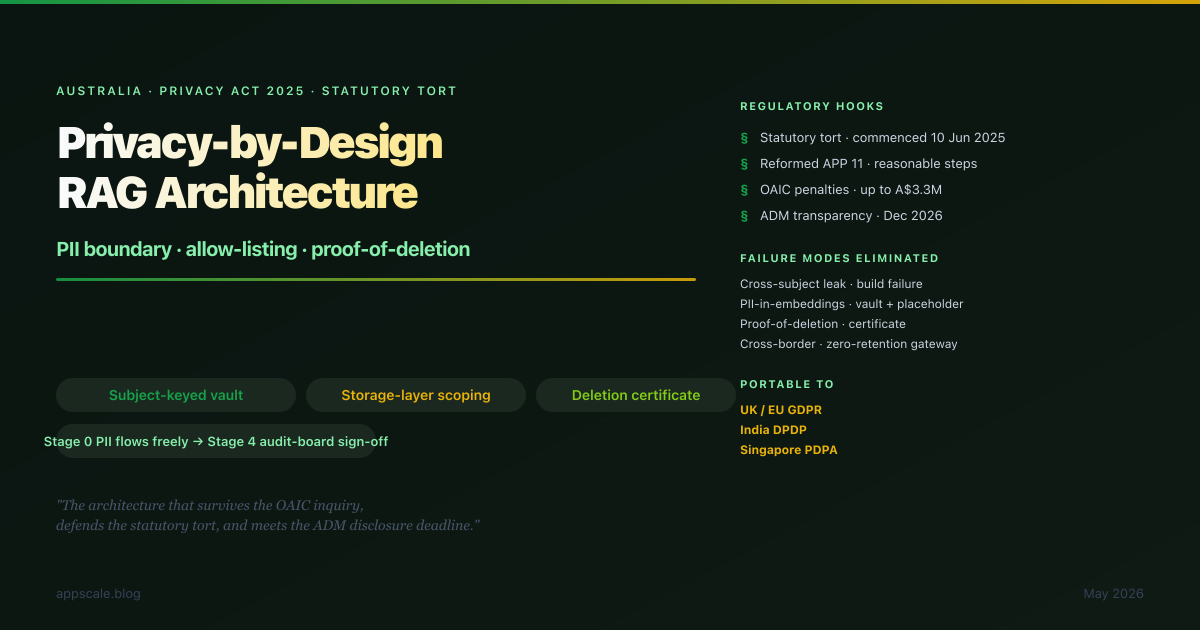
Privacy-by-Design RAG Architecture for the Australian Privacy Act 2025 Reforms and the Statutory Tort (2026)


A clause-by-clause architecture checklist for Articles 9–15 of the EU AI Act, the binding obligations for high-risk AI systems from 2 December 2027 (Annex III) after the Digital Omnibus. Seven articles, seven artefacts, one compliance-as-code pipeline. Risk file, dataset cards, technical file, logging pipeline, deployer instructions, human oversight architecture, and accuracy/robustness/cybersecurity test suite — all generated from the engineering repository, retained as immutable bundles, defensible at audit as a query rather than a project.
Fine-tuning, RAG, and prompt engineering answer three different questions — how should it behave, what should it know, what should it be told. A decision architecture.
AI system design interviews in 2026 are not the system design interviews of 2020. The senior bar now includes designing a multi-tenant LLM gateway, a real-time recommendation engine with two-tower retrieval and a learned-to-rank reranker, an image moderation pipeline grounded in policy, and a fraud detection system fusing streaming features with an online graph model. This guide walks through 15 of the most commonly asked AI system design questions — RAG, LLM gateway, recommendation, image generation, LLM search, inference platform, fraud, code review AI, voice assistant, evaluation platform, multi-agent orchestration, vector database, content moderation, MLOps, AI tutor — each with clarifying questions, capacity estimation, an architecture diagram, and the trade-offs interviewers listen for.
Chunking is the highest-leverage, most-neglected decision in RAG. Fixed vs recursive vs semantic vs late vs contextual retrieval — and the pipeline that ties them together.
Advertise and partner
Reach engineering leaders and CTOs reading about AI, mobile and cloud architecture.
Sponsored mentions and co-authored articles or technical deep-dives. Relevant products only, always disclosed.