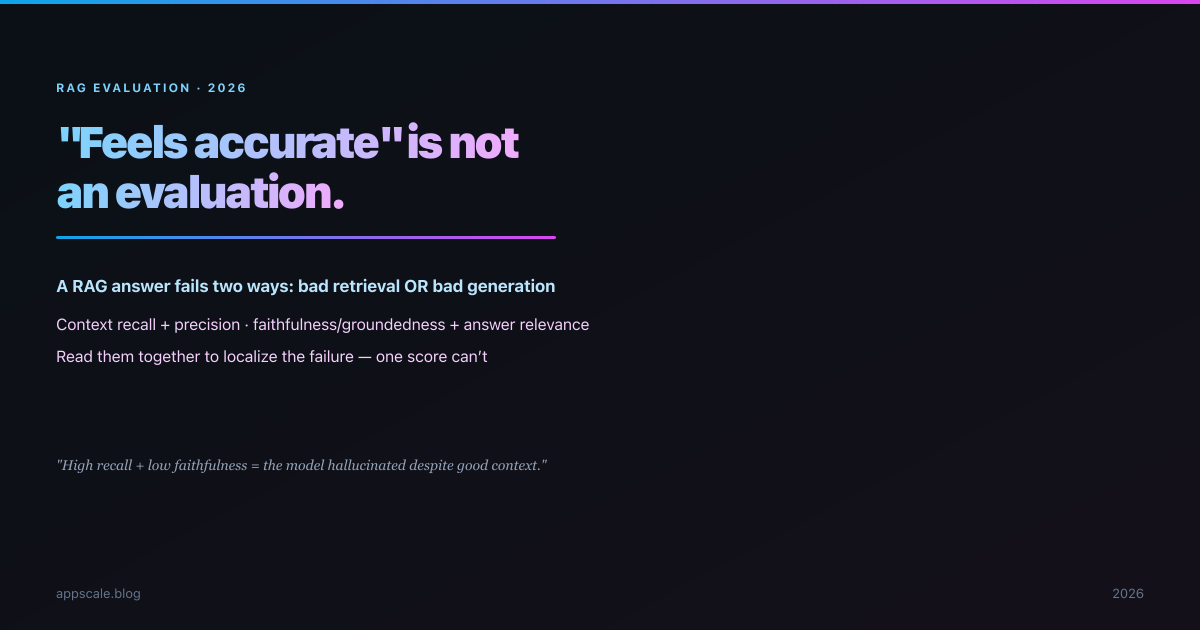
How to Actually Evaluate a RAG System in 2026: Faithfulness, Groundedness, and the Metrics That Catch Failures


Chunking is the highest-leverage, most-neglected decision in RAG. Fixed vs recursive vs semantic vs late vs contextual retrieval — and the pipeline that ties them together.
The honest reason most production RAG systems plateau is that dense-vector retrieval has no notion of a relationship. The retriever finds top-k cosine-similar chunks and hands them to the model; if the answer requires composing facts across three documents, vector RAG returns only the chunks lexically close to the query and silently drops the bridging fact. Microsoft GraphRAG named this in 2024; LightRAG offered a cheaper alternative in 2025; the 2026 conversation is no longer "should we add a graph" but "which slice of the workload deserves the graph and how do we compose vector and graph without doubling the indexing bill". This article is the deep-architecture decision guide: the multi-hop and global-query failure modes that motivate graphs, what pure vector RAG actually does and the workloads it serves well, the five-stage Microsoft GraphRAG pipeline and its honest cost (300x to 1000x vector indexing), LightRAG and the simpler-cheaper variants, Neo4j vector index for unified storage, three production hybrid architectures (vector-first plus graph expansion, graph-first with vector grounding, router-based dispatch), the decision framework by workload, indexing cost math worked through at 2026 prices, drift and freshness operational patterns, eight anti-patterns, five-stage maturity ladder.
Multi-tenant RAG has a security model that does not exist in single-tenant RAG and is not covered by generic SaaS multi-tenant discipline. The 2024–2025 incident record now has enough cross-tenant RAG leakage cases to classify the failure modes, and the result is a seven-vector taxonomy: cross-tenant retrieval leakage, embedding-space collisions, metadata-filter bypass, shared-index poisoning, re-ranker leakage, eval-set contamination, response-cache cross-talk. This article is the seven vectors with their mechanism and architectural defence, the per-tenant namespace pattern that closes them at every data surface, the eight anti-patterns that produce the bad outcomes, and the maturity ladder from Stage 0 (single shared everything) to Stage 4 (continuously-validated isolation).
The RAG pipeline that won 2024 — one question, one dense-vector lookup, one LLM call grounded on the top-k — is not the system that ships to production in 2026. The replacement is not bigger embeddings or a better re-ranker; it is the retrieval loop. Agentic RAG composes four architectural primitives: self-query decomposition that turns a multi-part question into a structured plan, plan-execute-replan with explicit iteration budgets that bound the loop, tool-augmented retrieval with a schema-driven router that chooses between dense indexes / SQL / graph / web search, and a validation loop with a sufficiency critic (gate to terminate-or-replan) and a faithfulness critic (deterministic gate before emission). Together they produce a bounded, observable, auditable retrieval agent. This article is the architecture-first playbook: what each primitive does, how they compose, the four failure modes specific to agentic RAG, eight anti-patterns that account for most production incidents, and the five-stage maturity ladder from classical-RAG-with-LLM-wrapper to full audit-grade deployment.
Advertise and partner
Reach engineering leaders and CTOs reading about AI, mobile and cloud architecture.
Sponsored mentions and co-authored articles or technical deep-dives. Relevant products only, always disclosed.