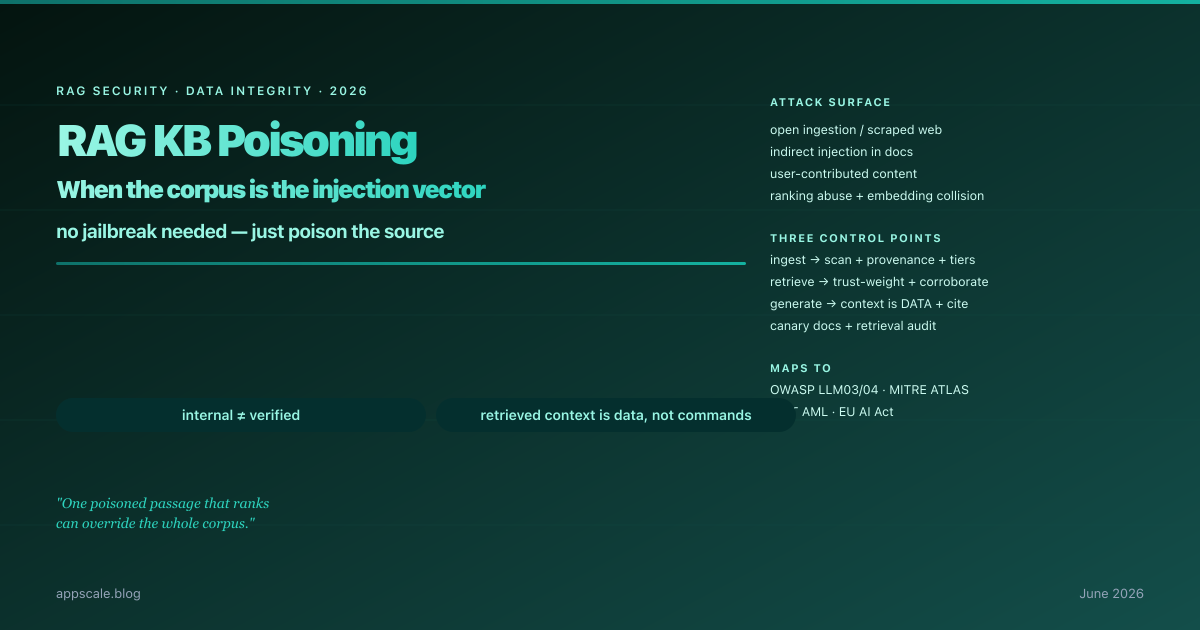
RAG Knowledge-Base Poisoning: How Attackers Corrupt Retrieval — and the Defense Architecture (2026)


Deepfake phishing defence for 2026: layered detection, C2PA content provenance, and the out-of-band callback protocol that defeats a flawless voice or video impersonation.
Most enterprise AI systems built on fixed-pipeline RAG architectures are leaving significant accuracy and reliability on the table. Modular RAG replaces the retrieve-stuff-generate pipeline with a dynamic decision graph, enabling systems to retrieve adaptively, critique their own outputs, and recover from poor retrieval before it determines the final answer. Production benchmarks show 30–40% accuracy improvements on complex, multi-source queries — the exact category of query that drives the most business value and carries the most operational risk. This article explains the architecture, the economics, the governance implications, and the strategic decisions leadership must make to build retrieval infrastructure that is genuinely fit for enterprise production.
Pure RAG retrieves similar text. Knowledge graphs retrieve relationships — and in enterprise knowledge, the relationships are usually what matters. This article explains GraphRAG architecture: how to combine a knowledge graph with vector search, build an entity extraction pipeline, implement Text-to-Cypher query generation, and choose when GraphRAG beats pure RAG for multi-hop reasoning, auditability, and structured fact retrieval.
Embeddings are not anonymised data — text, membership, and attributes can be reconstructed from vectors. The defence architecture for vector-store PII.
Advertise and partner
Reach engineering leaders and CTOs reading about AI, mobile and cloud architecture.
Sponsored mentions and co-authored articles or technical deep-dives. Relevant products only, always disclosed.