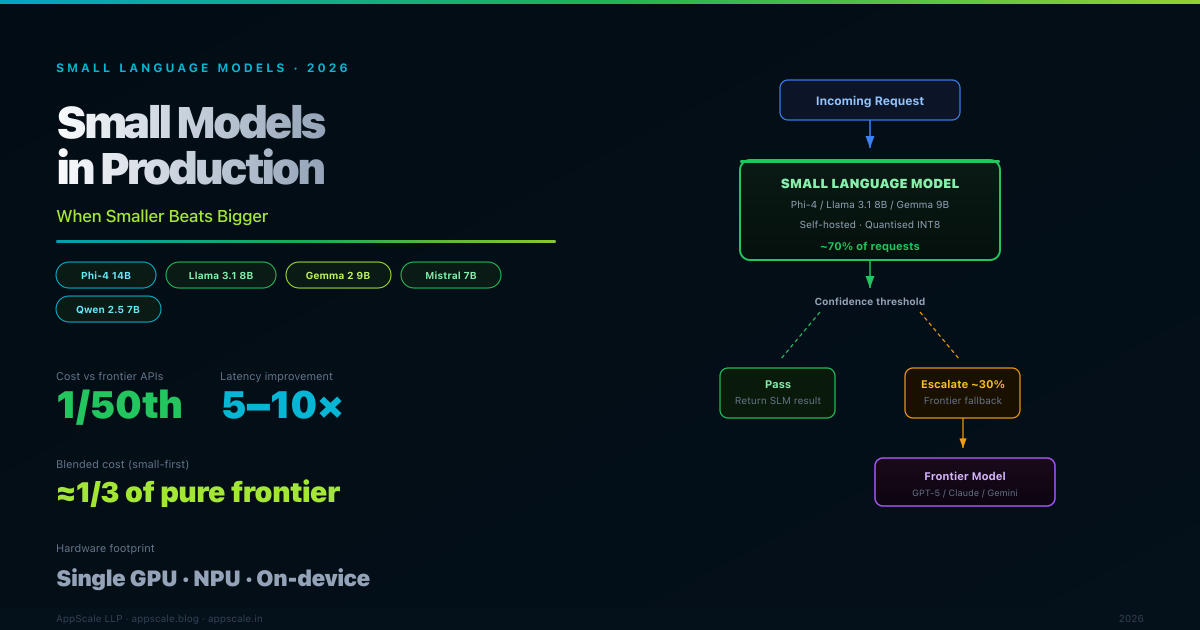
Small Language Models in Production: When Smaller Beats Bigger (2026)


Polish enterprises in 2026 face a choice they are largely unprepared for: pick a frontier model and live with the cost and residency consequences, or build a stack around domestic models (Bielik, PLLuM) and live with the eval discipline that requires. This article maps the three-tier Polish stack (Bielik · PLLuM · Frontier), the 5-axis decision framework, the 5-step workload-specific eval methodology, the eval-driven routing architecture, PL-specific operational considerations (tokenisation, 7-case inflection, formality register, sector corpora, safety evals, data residency under DPA/GDPR/EU AI Act), 8 anti-patterns, and the 5-stage maturity ladder. Portable to NL, CZ, HU, KR, TH, VN ecosystems.
The 2D particle scene flew on the laptop and melts on a real phone. PixiJS in production 2026: sprite batching, texture atlases, memory disposal, and WebGPU with WebGL fallback.
A specialized 7B model on the hospital’s own GPU never ships PHI off-site — and now matches larger models on medical exams. The private, on-prem clinical-AI architecture for 2026.
You maintain forty forecasting models. One pretrained model now beats them zero-shot. Time-series foundation models in production: benchmarking, covariates, uncertainty, serving.
Advertise and partner
Reach engineering leaders and CTOs reading about AI, mobile and cloud architecture.
Sponsored mentions and co-authored articles or technical deep-dives. Relevant products only, always disclosed.