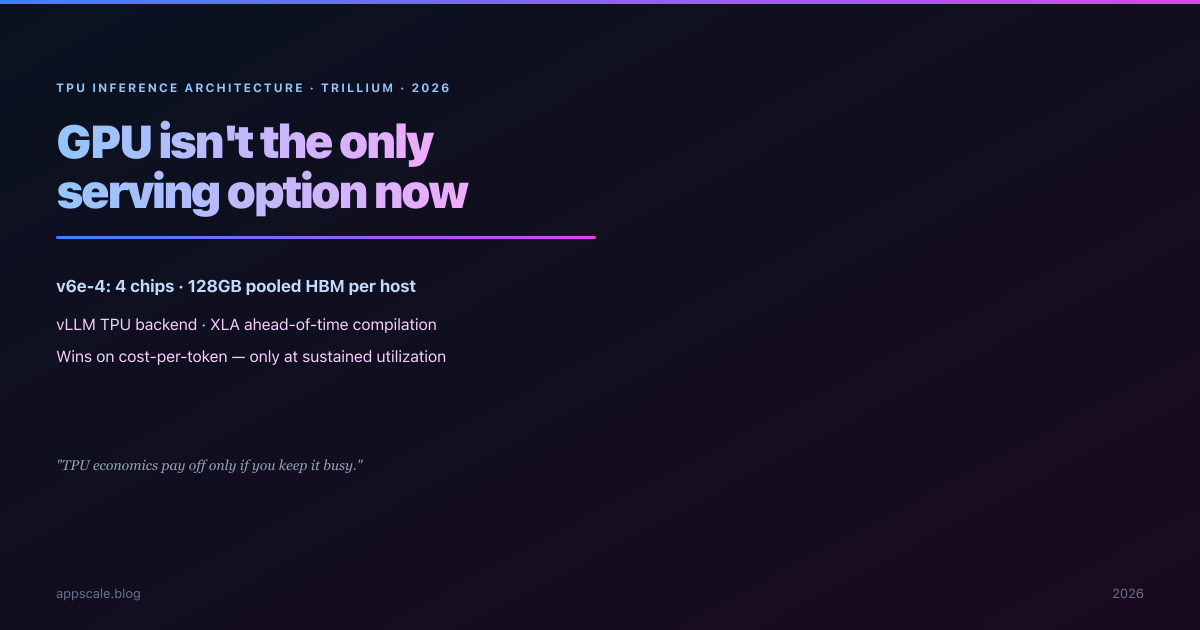
TPU Inference Architecture: Serving LLMs on Trillium with vLLM


Privacy by construction, zero per-token cost, fully offline. Ollama vs llama.cpp vs LM Studio vs vLLM — the honest comparison, hardware math, and when local loses.
The single largest under-used lever in production LLM inference in 2026 is speculative decoding. A correctly tuned vLLM deployment with EAGLE-3 or Medusa heads delivers 2.5–3.2× throughput on the same hardware for the same model with bit-exact outputs. The arithmetic: with α=0.8 acceptance, K=5 speculation length, and draft/target cost ratio c=0.08, the speedup formula (1 − α^(K+1)) / ((1 − α) × (K × c + 1)) lands around 2.4× and rises to 3× as α climbs. Most production deployments have not adopted it, not because the technique is exotic but because the operational subtleties — draft-model selection, acceptance-rate decay on long contexts, batch interaction effects, and the cases where naive speculation actively loses — are not well understood. This article is the production playbook: what speculative decoding actually does to the autoregressive loop, the EAGLE / Medusa / Lookahead / n-gram family, the vLLM integration surface, the four workload shapes where speculation wins or loses, the long-context failure mode that catches teams off-guard, eight anti-patterns, and a five-stage maturity ladder.
A classification backfill through the chat endpoint turned a $400 job into $3,000 and still failed. Batch LLM inference: half the cost, resumable, built for finite jobs.
A physical AI swarm is a moving distributed system with a hostile network. The architecture for edge inference, masterless coordination, resilient mesh comms, and local safety.
Advertise and partner
Reach engineering leaders and CTOs reading about AI, mobile and cloud architecture.
Sponsored mentions and co-authored articles or technical deep-dives. Relevant products only, always disclosed.