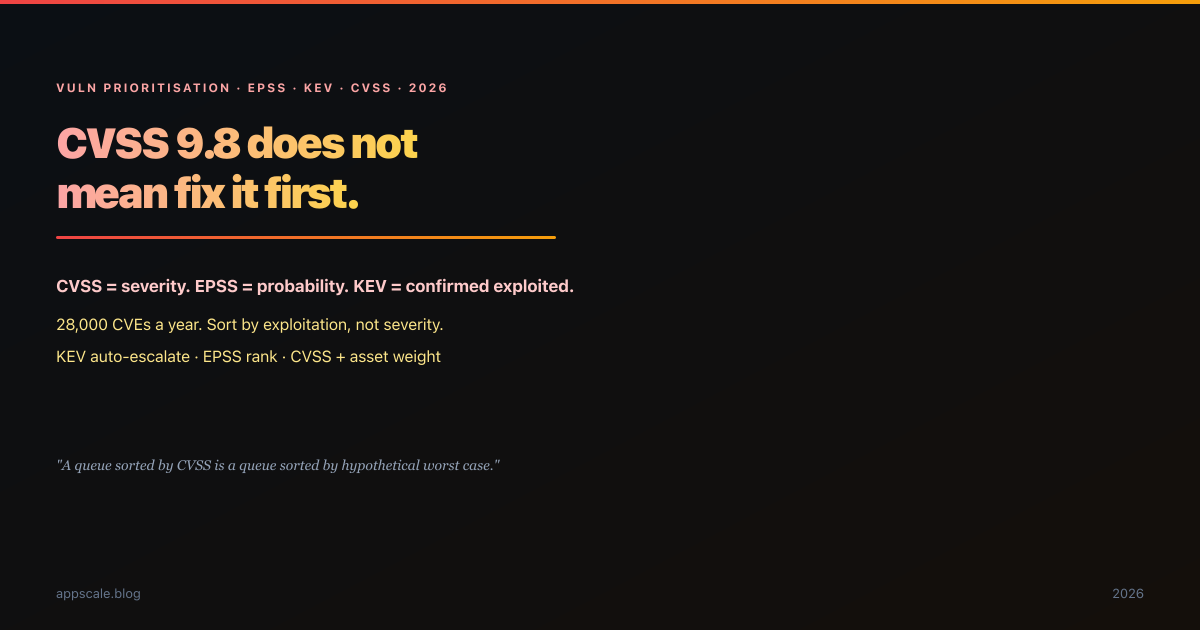
CVSS 9.8 Doesn't Mean Fix It First: Prioritising Vulnerabilities with EPSS and KEV


The single most expensive failure mode of an agentic system is not the agent producing the wrong answer — it is the agent producing no answer while burning through tool calls, context, and provider budget in a tight loop the runtime did not detect. Six failure modes (infinite tool-call loop, plan-execute oscillation, sub-agent recursion, context thrash, hallucinated arguments, silent budget burn), six detection signals (step cap, semantic similarity, cost slope, identical call, delegation depth, context utilisation), five containment primitives (hard step-cap, budget kill-switch, tool-call dedupe, plan-diff guard, supervisor halt), a state machine with running/watching/throttled/halted, a seven-field RCA template, 8 anti-patterns, and a 5-stage maturity ladder. This is how runaway loops become bounded incidents.
The decade-old JWT vs sessions fight has a boring answer: both, deliberately. Short access JWTs, rotating refresh tokens, httpOnly cookies, and a real revocation story.
A billing system double-charged 14 customers through a lock that worked exactly as documented. Redlock, fencing tokens, advisory locks, and when to delete the lock.
State space models like Mamba are linear-time alternatives to quadratic attention. But pure SSMs fail at exact recall, so production in 2026 means hybrids, not replacement.
Advertise and partner
Reach engineering leaders and CTOs reading about AI, mobile and cloud architecture.
Sponsored mentions and co-authored articles or technical deep-dives. Relevant products only, always disclosed.