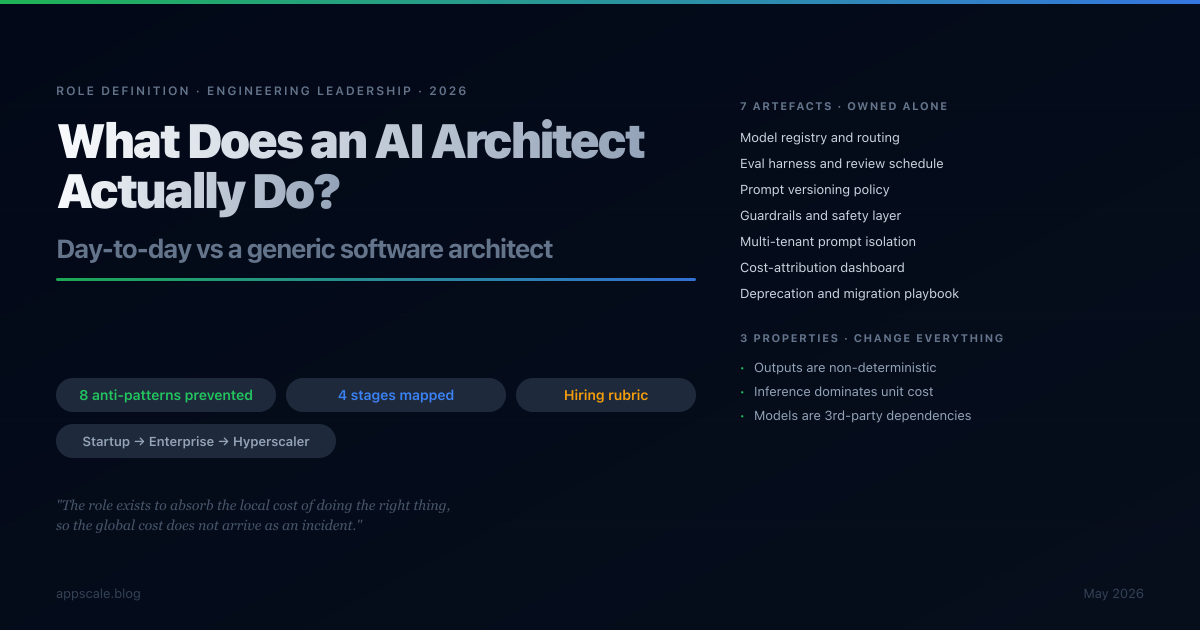
What Does an AI Architect Actually Do? Day-to-Day vs a Generic Software Architect (2026)


A three-person team can now scope a fifteen-person game — if the build runs as a pipeline. AI-assisted game dev in the Fable 5 era: direction bibles, verification gates, playtests.
A composite report drawn from 12 funded AI-first startups (pre-seed to Series A) — the Day-1 stack everyone converged on, the six-month walls every team hits, the 61% of the original stack that gets ripped out, and the cost trajectory from $94/month to $43k/month median. With a 2026 reference stack by stage and the trigger conditions for each upgrade.
Most AI system failures in production are not novel; they are repeat performances of a small number of well-known anti-patterns that teams keep rediscovering because the lessons are scattered across post-mortems that never get aggregated. This article bundles four of the most damaging into one reference: the unclassified query (treating every input as one category routed through one flow), the generic single-prompt (one giant 4-8k token system prompt covering every behaviour), monolithic safety (one configuration applied to every category and tenant regardless of differing requirements), and confident misclassification (the model is wrong but expresses high confidence so the system acts on the wrong answer). Each looks reasonable when small; each becomes a load-bearing failure mode as the system grows; each has a structural fix described in the dedicated positive patterns elsewhere in this series. The four share a structural theme — undifferentiated handling of inputs that have meaningfully different requirements — and they compound: each makes fixing the others harder. This article documents the failure modes, the detection signatures, the unwinding order, and a production case study that improved every metric.
The single index to 50+ production AI architecture patterns — retrieval, agents, serving, evaluation, security, cost — with decision tables and anti-patterns.
Advertise and partner
Reach engineering leaders and CTOs reading about AI, mobile and cloud architecture.
Sponsored mentions and co-authored articles or technical deep-dives. Relevant products only, always disclosed.