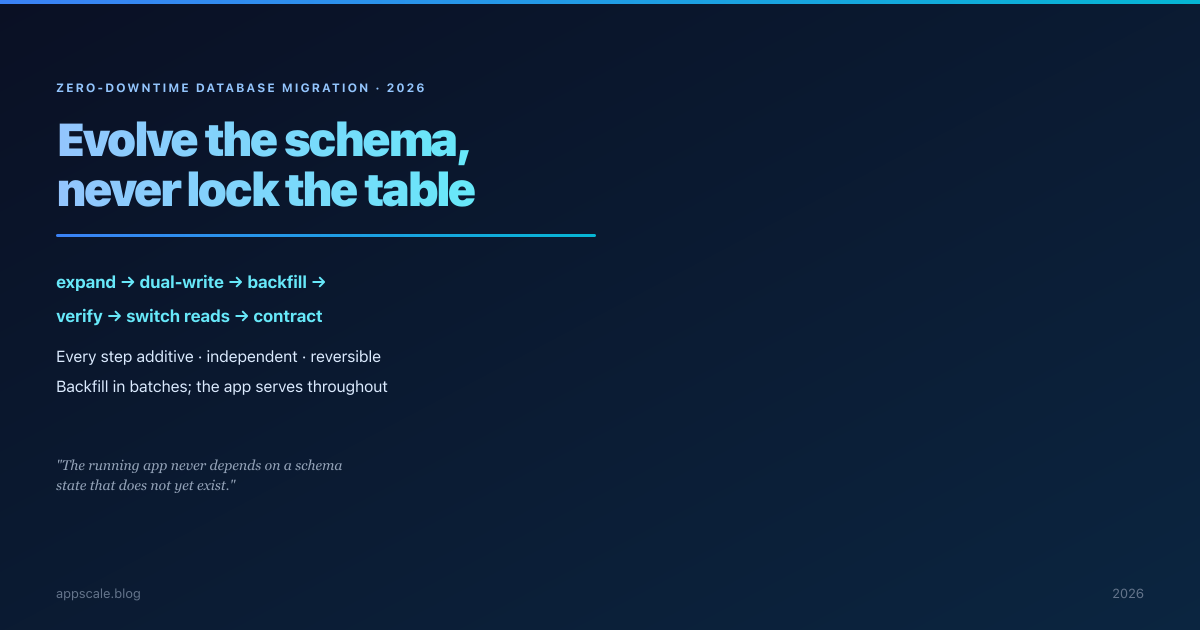
Zero-Downtime Database Migration Architecture: Expand-Contract, Dual-Write & Backfill


Zero trust is the security posture in which no network location, no identity, and no prior authentication is treated as inherently trustworthy — every access decision is made fresh, against current context, on the principle of least privilege, with continuous verification rather than perimeter assumption. This article maps the NIST 800-207 components onto AI-specific components: model endpoints, agent runtimes, tool gateways, retrieval indexes, fine-tuning jobs, and model artefacts. It walks through a threat model that names the realistic adversaries, presents a reference architecture diagram that names every enforcement point, and concludes with the operational disciplines (audit, behaviour analytics, key rotation, supply-chain attestation) that distinguish a zero-trust AI system from a conventional AI system with a few extra firewalls.
The same query: 2ms or 3,000ms — the difference is one B-tree. How database indexes actually work, composite column order, covering indexes, and when the planner says no.
An AI product built in Bengaluru that serves a German healthcare buyer is governed by two regulators that do not coordinate — DPDP in India and the EU AI Act in Europe. This article is the architect's reference for shipping an India-EU AI platform that satisfies both regimes from one codebase: the DPDP versus AI Act overlap matrix, data residency arithmetic for India localisation alongside GDPR cross-border rules, the dual consent ledger that captures both DPDP notice-acknowledgement and GDPR lawful basis, the combined DPIA-FRIA workflow, the role mapping between Data Fiduciary, Provider, and Deployer, the SCC + TIA mechanics for EU-to-India transfers, and a reference architecture with shared control plane and regional data planes.
A vector database is a recall/latency/memory machine behind a similarity-search API. How to choose pgvector, Pinecone, Qdrant, or Weaviate — and what breaks first as it scales.
Advertise and partner
Reach engineering leaders and CTOs reading about AI, mobile and cloud architecture.
Sponsored mentions and co-authored articles or technical deep-dives. Relevant products only, always disclosed.