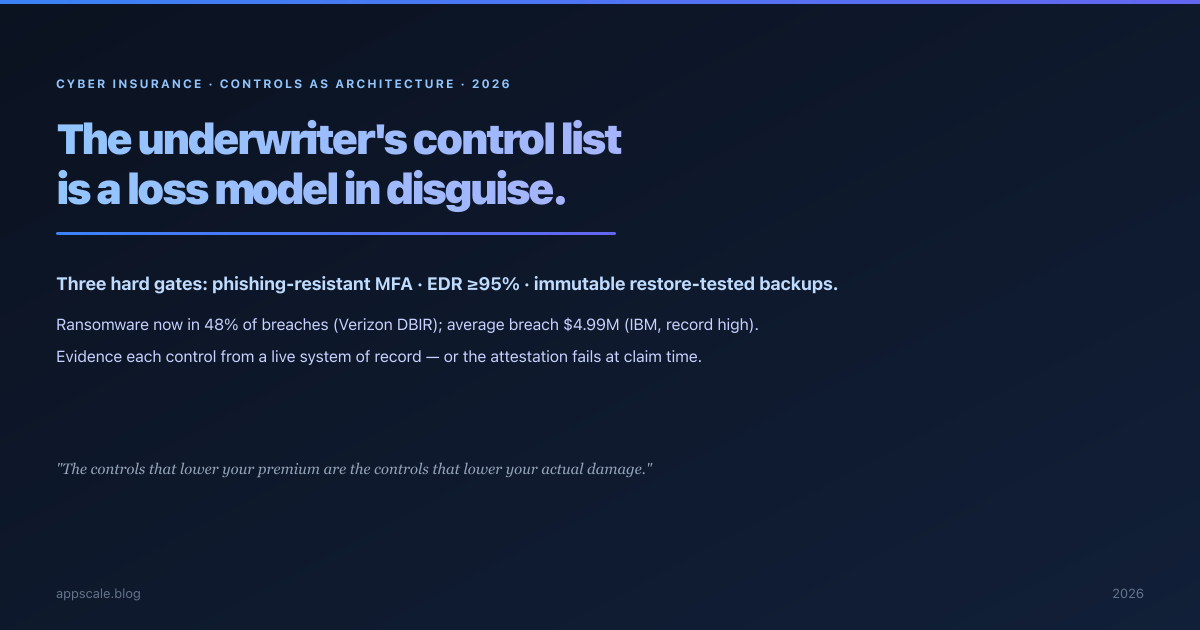
Cyber Insurance Controls Mapped to Architecture: What Underwriters Actually Require (2026)


The OWASP Top 10 for LLM Applications gave the industry a shared vocabulary for LLM risk in 2023 and a sharper, incident-evidenced revision in 2025. What it never gave — and was never intended to give — is the architecture that actually contains those risks in production. This article walks the 2025 list, and for each of the ten risks specifies the architectural mitigation that contains it, the topological layer where the mitigation lives (gateway, retrieval, model serving, agent loop, output handling, observability), the telemetry that proves it is working, and the common failure modes when teams treat the list as a checklist rather than a pipeline-architecture specification. New entries in the 2025 revision — System Prompt Leakage (LLM07), Vector and Embedding Weaknesses (LLM08), Unbounded Consumption (LLM10) — are addressed with the same per-risk architectural placement. The article closes with eight anti-patterns and a five-stage maturity ladder from "we read the list" to a continuous adversarial-testing capability that exercises the pipeline daily.
OT security inverts IT priorities — availability and safety first. A 2026 guide to Purdue zones and conduits, protocol gateways, data diodes and patching by reachability, not CVSS.
The EU Cyber Resilience Act reporting duty lands 11 September 2026. It is a product security contract — here is the SBOM, support-period and incident architecture it forces.
A NIS2 compliance blueprint: map the Article 21 measures to cloud controls, engineer the 24h/72h reporting clock, and reuse one control set across GDPR, the EU AI Act, and DORA.
Advertise and partner
Reach engineering leaders and CTOs reading about AI, mobile and cloud architecture.
Sponsored mentions and co-authored articles or technical deep-dives. Relevant products only, always disclosed.