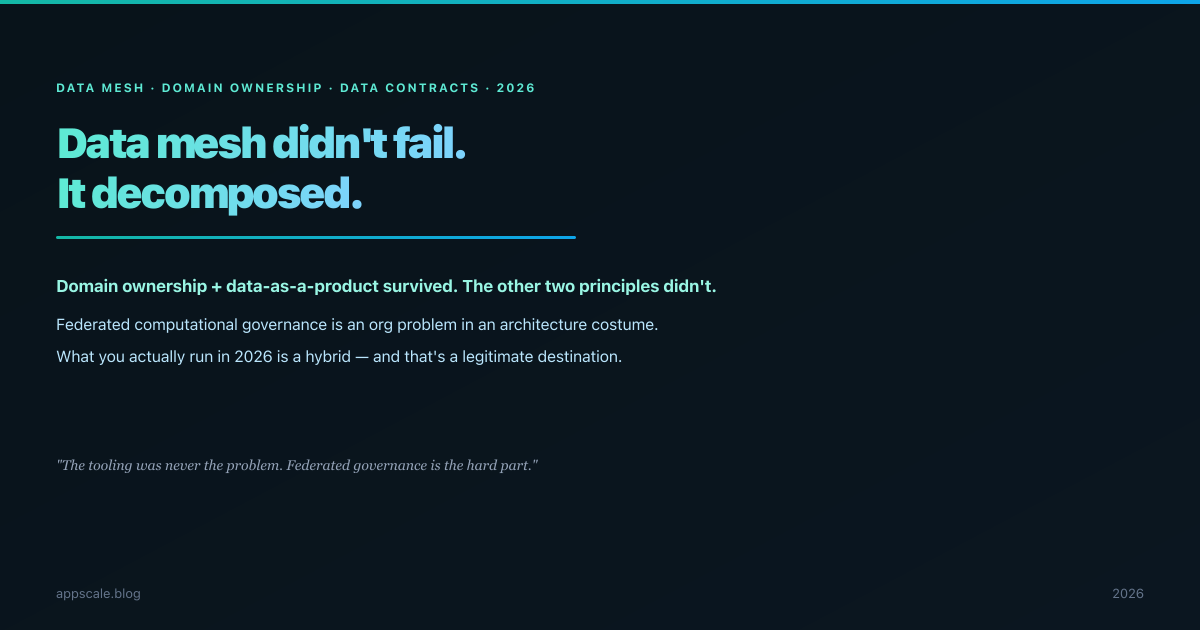
Data Mesh, Five Years On: What Survived Contact With Production


When a column changes, the consumer pipeline breaks at 3am. Data contracts flip ownership: the producer commits to schema, semantics and freshness, enforced in CI.
The service mesh moves cross-cutting networking concerns — mTLS, retries, timeouts, circuit breaking, traffic shaping, authorisation, and east-west observability — out of application code and into a uniform infrastructure layer. This guide covers when a mesh is worth adopting and when it is not, the data plane / control plane architecture, the leading implementations (Istio, Linkerd, Cilium Service Mesh, Consul Connect), production configuration patterns with Istio, the latency and resource cost (and how ambient mode and eBPF approaches change the calculus), and the operational practices that determine whether a mesh deployment delivers value or accumulates debt.
The single biggest mistake in production AI safety is treating the guardrail layer as a global, category-blind filter. Run medical, legal, finance, code, and general queries through one global guardrail and you get the worst of both worlds: under-protected high-risk categories, over-restricted general traffic, and a guardrail layer that fails compliance audit. Category-aware guardrails fix this by treating safety as a per-domain policy executed after the classification-first router has decided which category a request belongs to. This article covers the pattern in detail: structuring per-category policies (medical, legal, finance, code, general), integration with the classification-first router, the production case study showing 2.4s → 1.3s latency and 11% → 1.4% false-positive reduction, the anti-patterns that defeat the pattern, and the configuration values that work at scale.
Sidecarless meshes do not make L7 cheaper; they let you stop buying L7 for services that never used it. Istio ambient vs Cilium eBPF vs sidecars, with the honest limits.
Advertise and partner
Reach engineering leaders and CTOs reading about AI, mobile and cloud architecture.
Sponsored mentions and co-authored articles or technical deep-dives. Relevant products only, always disclosed.