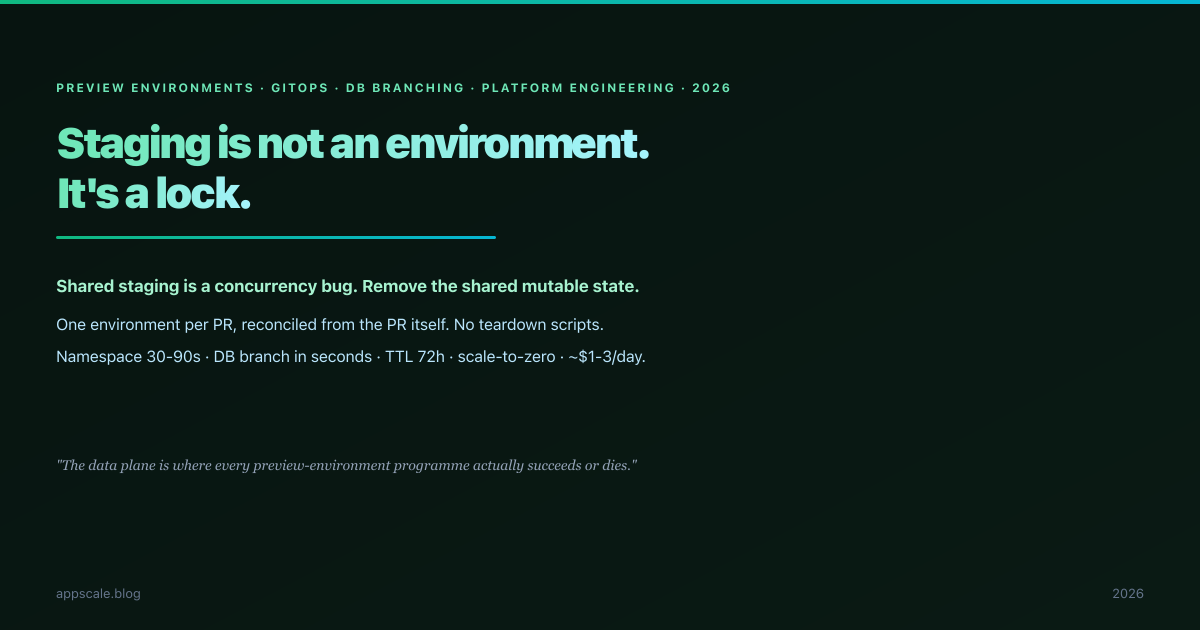
Ephemeral Preview Environments: On-Demand Provisioning Without the Staging Queue


The request cycle is for accepting work; the queue is for doing it. BullMQ vs Celery vs Sidekiq vs SQS, the five production requirements, and the AI-batch job shape.
An agent mesh is what you end up with when you stop pretending one orchestrator can coordinate every autonomous capability in your enterprise. The orchestrator-as-central-brain works for ten agents, struggles at fifty, collapses at two hundred. The mesh is the alternative posture: agents discover each other through a registry, communicate through a message bus, negotiate work through coordinator-free patterns (gossip, role auctions, blackboards), and observe each other through trace propagation that survives asynchronous boundaries. This article covers the four topologies, the message bus options (NATS, Kafka, EventBridge), the coordinator-free coordination patterns, the role registry and capability discovery layer, observability across asynchronous agent boundaries, failure isolation through per-agent circuit breakers and dead-letter handling, and a reference implementation on NestJS plus AWS Bedrock with sequence diagrams.
A reference architecture for offline LLM systems in air-gapped environments. Covers signed update flows, local registries, offline retrieval, observability, security controls, and the real cost profile of air-gapped AI.
Clean rooms are query policy engines, not storage. How identity matching, analysis rules and privacy budgets let partners compute joins without handing over data.
Advertise and partner
Reach engineering leaders and CTOs reading about AI, mobile and cloud architecture.
Sponsored mentions and co-authored articles or technical deep-dives. Relevant products only, always disclosed.