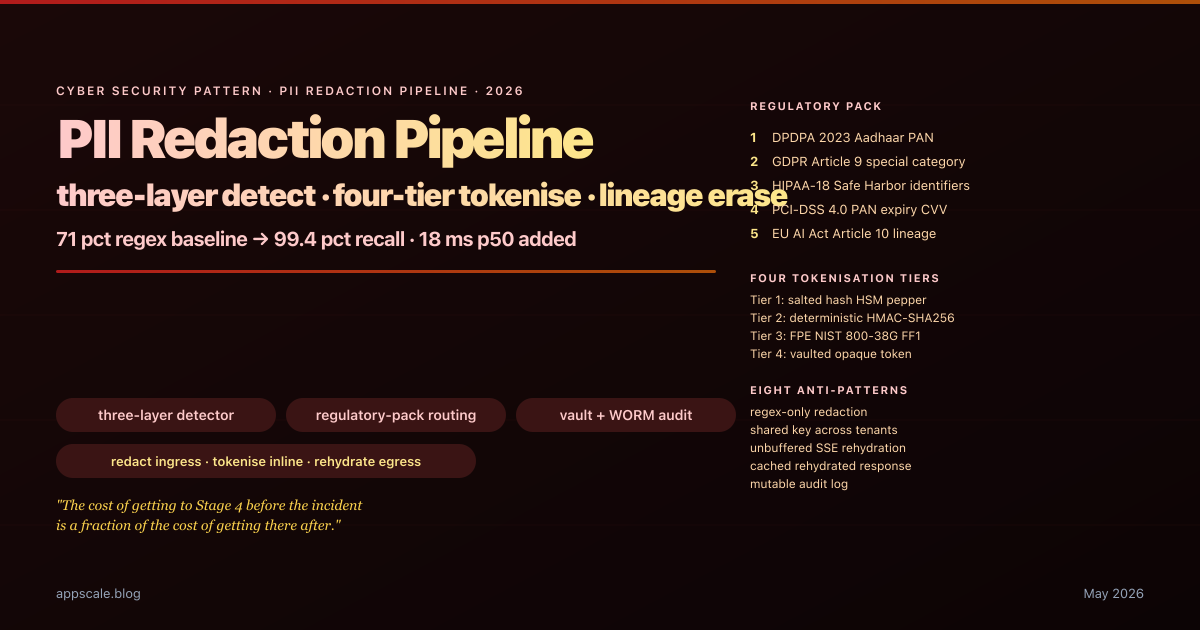
PII Redaction Pipeline Architecture for LLM Workloads — Presidio, NER, and Reversible Tokenisation (2026)


Even an aligned model under prompt injection emits unsafe output. Output guardrails are the deterministic layer that validates every response before it becomes consequential.
Logs are the most-replicated copy of your sensitive data. Redact PII and secrets at emit — not at read — and treat the log pipeline as a DLP export path.
The OWASP Top 10 for LLM Applications gave the industry a shared vocabulary for LLM risk in 2023 and a sharper, incident-evidenced revision in 2025. What it never gave — and was never intended to give — is the architecture that actually contains those risks in production. This article walks the 2025 list, and for each of the ten risks specifies the architectural mitigation that contains it, the topological layer where the mitigation lives (gateway, retrieval, model serving, agent loop, output handling, observability), the telemetry that proves it is working, and the common failure modes when teams treat the list as a checklist rather than a pipeline-architecture specification. New entries in the 2025 revision — System Prompt Leakage (LLM07), Vector and Embedding Weaknesses (LLM08), Unbounded Consumption (LLM10) — are addressed with the same per-risk architectural placement. The article closes with eight anti-patterns and a five-stage maturity ladder from "we read the list" to a continuous adversarial-testing capability that exercises the pipeline daily.
A NIS2 compliance blueprint: map the Article 21 measures to cloud controls, engineer the 24h/72h reporting clock, and reuse one control set across GDPR, the EU AI Act, and DORA.
Advertise and partner
Reach engineering leaders and CTOs reading about AI, mobile and cloud architecture.
Sponsored mentions and co-authored articles or technical deep-dives. Relevant products only, always disclosed.