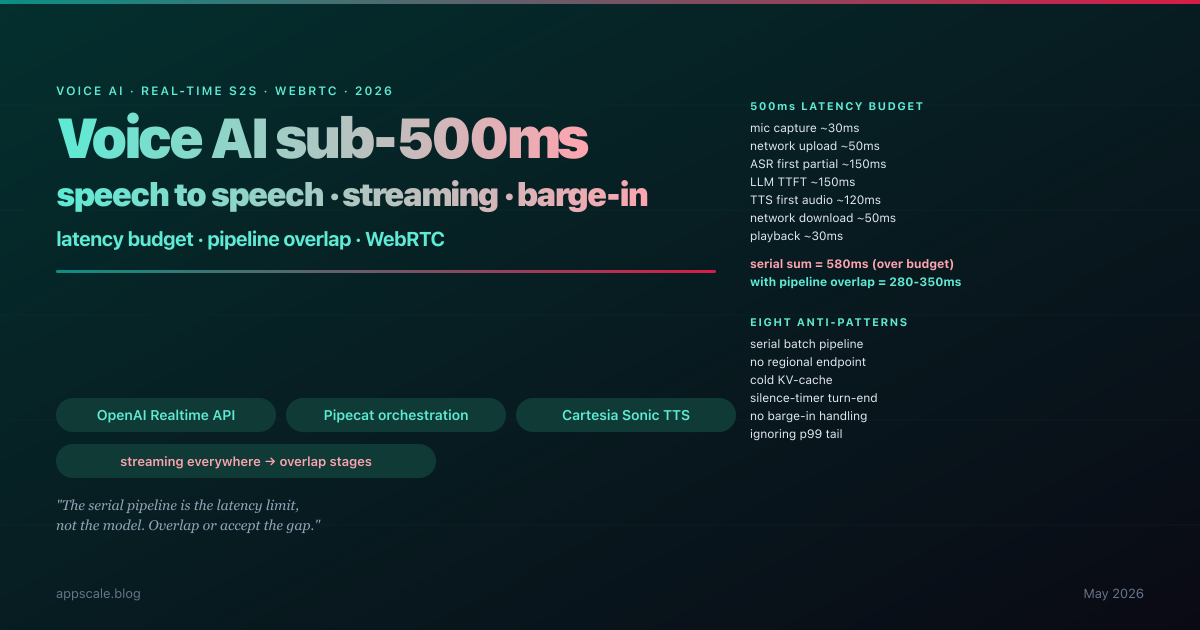
Voice AI Architecture in 2026: How to Hit Sub-500ms Speech-to-Speech Latency Without Faking It


An agent mesh is what you end up with when you stop pretending one orchestrator can coordinate every autonomous capability in your enterprise. The orchestrator-as-central-brain works for ten agents, struggles at fifty, collapses at two hundred. The mesh is the alternative posture: agents discover each other through a registry, communicate through a message bus, negotiate work through coordinator-free patterns (gossip, role auctions, blackboards), and observe each other through trace propagation that survives asynchronous boundaries. This article covers the four topologies, the message bus options (NATS, Kafka, EventBridge), the coordinator-free coordination patterns, the role registry and capability discovery layer, observability across asynchronous agent boundaries, failure isolation through per-agent circuit breakers and dead-letter handling, and a reference implementation on NestJS plus AWS Bedrock with sequence diagrams.
Most AI value in a business is glue. n8n vs Zapier vs Make vs custom code, the LLM/agent/RAG node layer, the flows that earn money, and how to run it seriously.
An enterprise spent nine months duplicating its AI stack across two clouds; every real incident was a quota ceiling. Multi-provider routing: the architecture that pays.
A team running a customer-support assistant on GPT-4o reported a beautiful number to their CFO: 47% cache hit-rate, $18,000 per month saved, p95 latency down from 2.4s to 380ms. Three weeks later the same team was reading a customer-trust incident report. The semantic cache had decided two refund-policy questions were "the same enough" at cosine similarity 0.93 — and 0.93 had been a reasonable threshold on the eval set, which had not contained two refund policies. The cache was not broken; the cache was working exactly as designed. The architecture was wrong. This article is the deep-architecture answer to the question the team had not asked: when does semantic cache help, and when does it lie? Four-tier hierarchy from exact-key through normalised through semantic to LLM, three-step threshold calibration using a risk-weighted decision rule, multi-tenant key design that prevents the cross-tenant-pollution incident, TTL and model-version discipline, eight failure patterns to retire, five-stage maturity ladder, and the Monday-morning checklist that ships sustainable savings without the customer-trust incidents.
Advertise and partner
Reach engineering leaders and CTOs reading about AI, mobile and cloud architecture.
Sponsored mentions and co-authored articles or technical deep-dives. Relevant products only, always disclosed.