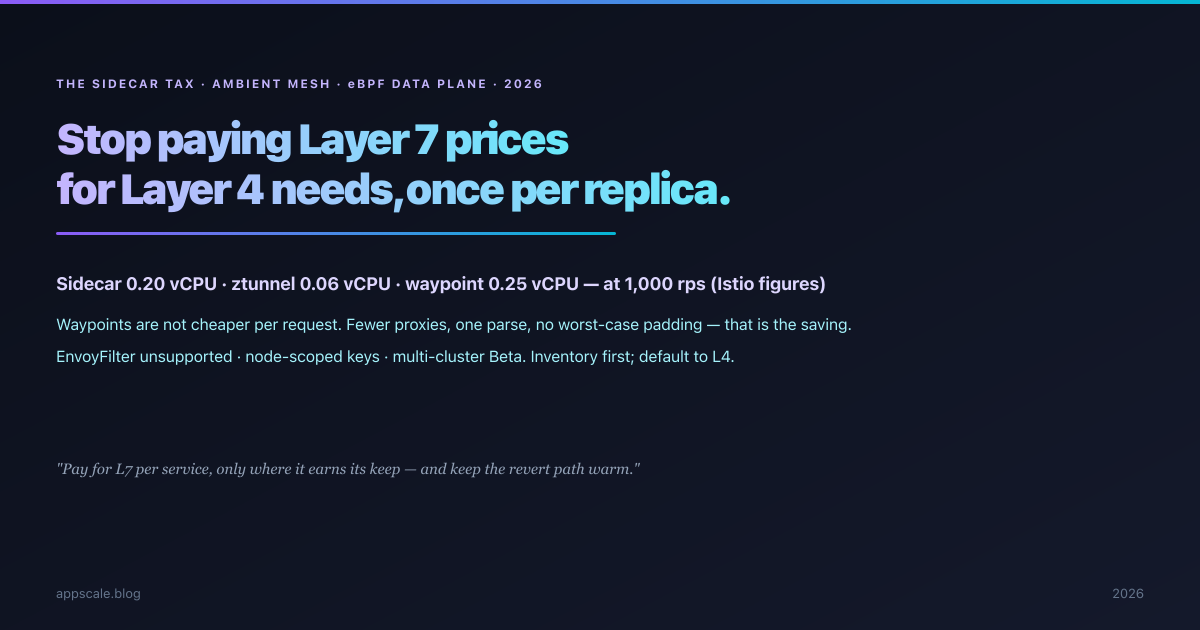
The Sidecar Tax: Ambient Mesh, the eBPF Data Plane, and What a Sidecarless Migration Actually Buys (2026)


Five years on, two of data mesh’s four principles survived and two were abandoned. What domain ownership, data-as-a-product, federated governance and self-serve became.
Most teams that say they "do DDD" have a folder called domain/ and occasional meetings with a product manager. The genuine practice — bounded contexts that match the business, aggregates that protect invariants, ubiquitous language that survives the trip from whiteboard to code — is rare because it is harder than its surface description. NestJS is one of the few back-end frameworks whose primitives are well-suited to a serious DDD implementation. This guide covers bounded context mapping, aggregate sizing, the ideal layered folder structure, the repository pattern done correctly versus the DAO that pretends to be one, domain events through the in-process bus, and composition with the Saga, Outbox, and Event-Driven Architecture patterns.
Backend-for-Frontend in 2026: one BFF per client experience, GraphQL Federation vs tRPC vs REST per client-shape, Edge BFFs, and eight production anti-patterns.
The Saga and Outbox patterns are most often essential when combined. This article is the production recipe for combining them: the five invariants you must preserve, the schemas, the state machine, six failure modes the combination survives, common implementation mistakes, observability, and an incremental migration path from a synchronous chained-call implementation. With four Mermaid diagrams, full SQL schemas, and a 30-question FAQ.
Advertise and partner
Reach engineering leaders and CTOs reading about AI, mobile and cloud architecture.
Sponsored mentions and co-authored articles or technical deep-dives. Relevant products only, always disclosed.