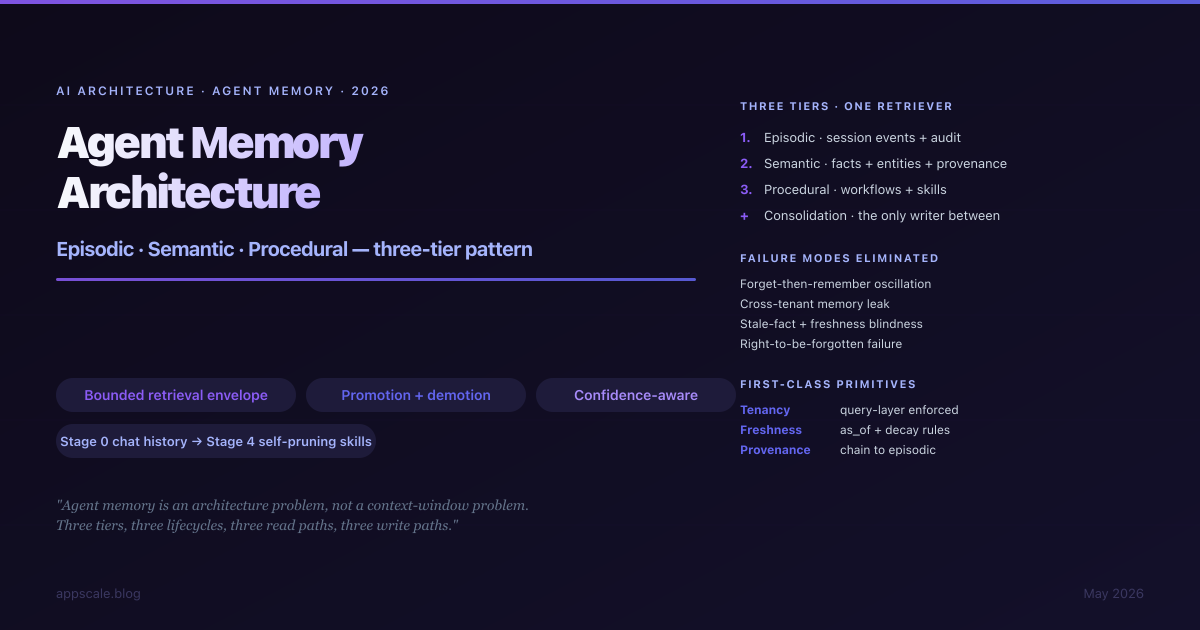
Agent Memory Architecture: Episodic, Semantic, Procedural — the Three-Tier Pattern (2026)


A team running a customer-support assistant on GPT-4o reported a beautiful number to their CFO: 47% cache hit-rate, $18,000 per month saved, p95 latency down from 2.4s to 380ms. Three weeks later the same team was reading a customer-trust incident report. The semantic cache had decided two refund-policy questions were "the same enough" at cosine similarity 0.93 — and 0.93 had been a reasonable threshold on the eval set, which had not contained two refund policies. The cache was not broken; the cache was working exactly as designed. The architecture was wrong. This article is the deep-architecture answer to the question the team had not asked: when does semantic cache help, and when does it lie? Four-tier hierarchy from exact-key through normalised through semantic to LLM, three-step threshold calibration using a risk-weighted decision rule, multi-tenant key design that prevents the cross-tenant-pollution incident, TTL and model-version discipline, eight failure patterns to retire, five-stage maturity ladder, and the Monday-morning checklist that ships sustainable savings without the customer-trust incidents.
The agent that dazzled in week one is confidently wrong by month six — its memory only grows, never expires. Context rot, staleness, and the invalidation fix.
A lakehouse is a warehouse’s table semantics on a lake’s cheap storage, organised by the medallion pattern and kept alive by compaction and governance. How to architect one.
Semantic search and keyword search answer fundamentally different questions — one matches vocabulary, the other matches meaning. This article covers the architecture of both approaches, their failure modes, the hybrid architecture that most production systems use, and the full implementation pipeline: document chunking, embedding service design, vector store selection, query pipeline, reranking, and evaluation metrics.
Advertise and partner
Reach engineering leaders and CTOs reading about AI, mobile and cloud architecture.
Sponsored mentions and co-authored articles or technical deep-dives. Relevant products only, always disclosed.