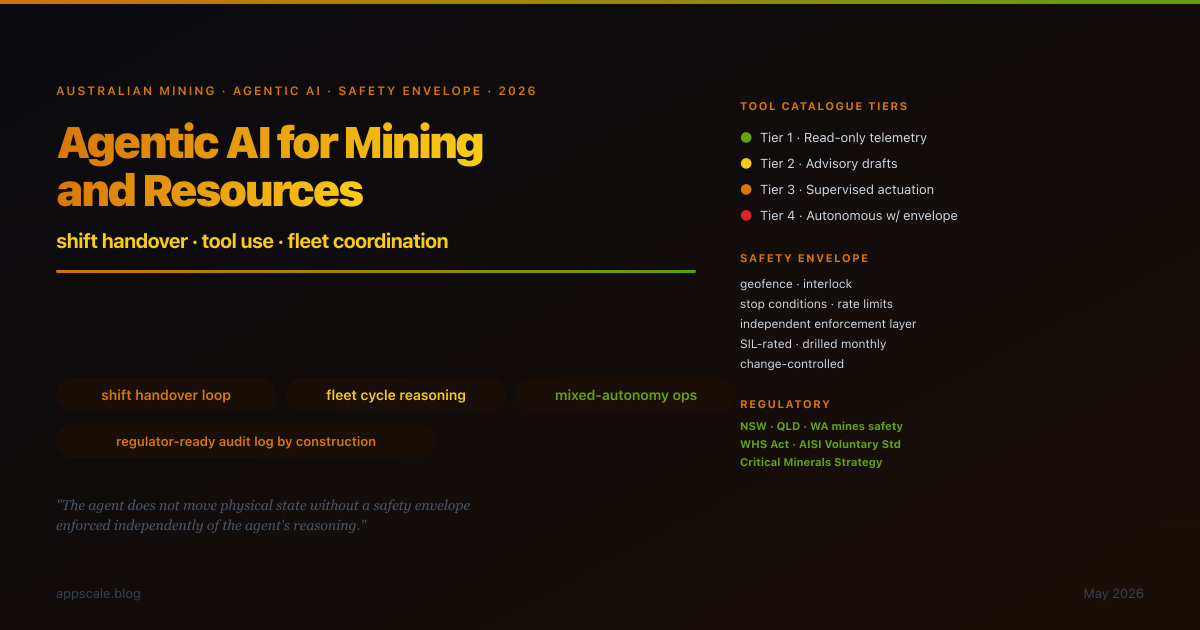
Agentic AI for Mining and Resources: Shift Handover, Tool Use, and Fleet Coordination (2026)


The single most expensive failure mode of an agentic system is not the agent producing the wrong answer — it is the agent producing no answer while burning through tool calls, context, and provider budget in a tight loop the runtime did not detect. Six failure modes (infinite tool-call loop, plan-execute oscillation, sub-agent recursion, context thrash, hallucinated arguments, silent budget burn), six detection signals (step cap, semantic similarity, cost slope, identical call, delegation depth, context utilisation), five containment primitives (hard step-cap, budget kill-switch, tool-call dedupe, plan-diff guard, supervisor halt), a state machine with running/watching/throttled/halted, a seven-field RCA template, 8 anti-patterns, and a 5-stage maturity ladder. This is how runaway loops become bounded incidents.
AI agents are becoming buyers, and checkout assumed a human. AP2 mandates, ACP buy-in-chat, and x402 micropayments — the architecture merchants and platforms must build.
An agent mesh is what you end up with when you stop pretending one orchestrator can coordinate every autonomous capability in your enterprise. The orchestrator-as-central-brain works for ten agents, struggles at fifty, collapses at two hundred. The mesh is the alternative posture: agents discover each other through a registry, communicate through a message bus, negotiate work through coordinator-free patterns (gossip, role auctions, blackboards), and observe each other through trace propagation that survives asynchronous boundaries. This article covers the four topologies, the message bus options (NATS, Kafka, EventBridge), the coordinator-free coordination patterns, the role registry and capability discovery layer, observability across asynchronous agent boundaries, failure isolation through per-agent circuit breakers and dead-letter handling, and a reference implementation on NestJS plus AWS Bedrock with sequence diagrams.
Most AI value in a business is glue. n8n vs Zapier vs Make vs custom code, the LLM/agent/RAG node layer, the flows that earn money, and how to run it seriously.
Advertise and partner
Reach engineering leaders and CTOs reading about AI, mobile and cloud architecture.
Sponsored mentions and co-authored articles or technical deep-dives. Relevant products only, always disclosed.