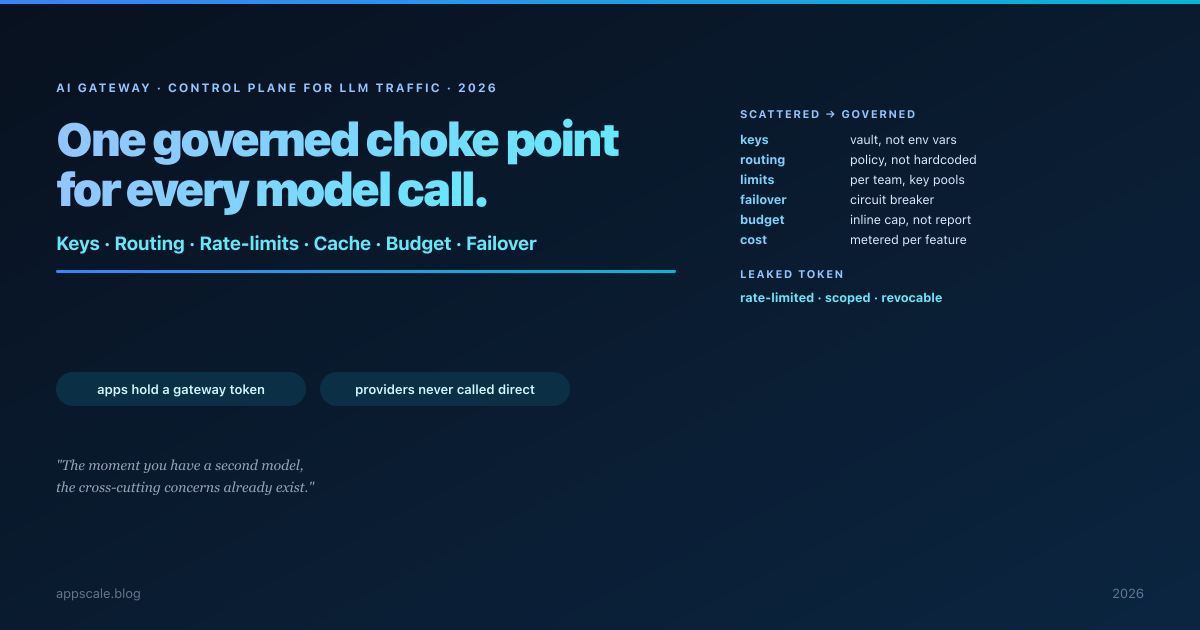
AI Gateway Architecture: The Control Plane for Production LLM Traffic


Every mature AI platform running multiple LLM-powered features converges on a single architectural decision: centralise the interface to language model providers. This guide covers the six core functions of a production LLM gateway — routing, rate limiting, circuit breaking, semantic caching, virtual key management, and observability — with implementation patterns and build-versus-buy analysis.
An enterprise spent nine months duplicating its AI stack across two clouds; every real incident was a quota ceiling. Multi-provider routing: the architecture that pays.
New Zealand's Algorithm Charter is short, principle-based, and signatory-voluntary — and it operationalises into a production-grade AI governance architecture that is portable across the Westminster-tradition public sector (CA, AU, IE, UK). This article maps each of the six commitments (Transparency, Partnership / Te Tiriti, People, Data, Privacy / Ethics / Rights, Human Oversight) to deliverable architectural artefacts (algorithm register, model card, DPIA, iwi engagement record, TMR plan, affected-people impact narrative, audit log, oversight thresholds, explainability report). Includes the artefact register pattern, 8 anti-patterns, and the 5-stage maturity ladder.
A production-grade reference for building AI agents on AWS Bedrock with a NestJS gateway in 2026 — Bedrock AgentCore, action groups backed by Lambda, knowledge bases over S3 + OpenSearch, the routing-and-guardrail layer that NestJS must own, the model-selection cost arithmetic, three-layer observability (gateway + agent-internal + per-token cost), Bedrock Guardrails plus app-specific PII redaction, multi-agent collaboration patterns, and the failure modes you only learn about by running this in production.
Advertise and partner
Reach engineering leaders and CTOs reading about AI, mobile and cloud architecture.
Sponsored mentions and co-authored articles or technical deep-dives. Relevant products only, always disclosed.