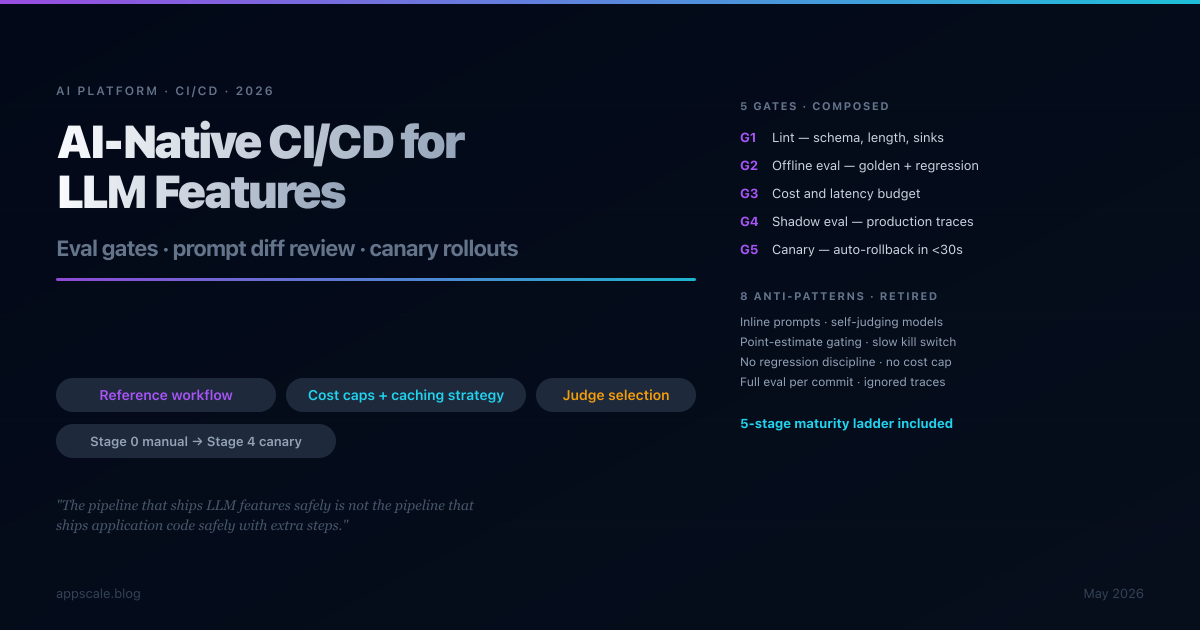
AI-Native CI/CD for LLM Features: Eval Gates, Prompt Diff Review, Canary Rollouts (2026)


A team running a customer-support assistant on GPT-4o reported a beautiful number to their CFO: 47% cache hit-rate, $18,000 per month saved, p95 latency down from 2.4s to 380ms. Three weeks later the same team was reading a customer-trust incident report. The semantic cache had decided two refund-policy questions were "the same enough" at cosine similarity 0.93 — and 0.93 had been a reasonable threshold on the eval set, which had not contained two refund policies. The cache was not broken; the cache was working exactly as designed. The architecture was wrong. This article is the deep-architecture answer to the question the team had not asked: when does semantic cache help, and when does it lie? Four-tier hierarchy from exact-key through normalised through semantic to LLM, three-step threshold calibration using a risk-weighted decision rule, multi-tenant key design that prevents the cross-tenant-pollution incident, TTL and model-version discipline, eight failure patterns to retire, five-stage maturity ladder, and the Monday-morning checklist that ships sustainable savings without the customer-trust incidents.
The first instinct when wiring observability into an LLM system is to treat the LLM call as just another HTTP outbound call. Within a week the team realises conventional observability is missing everything that matters — the span tells you the call took 4.2 seconds and returned 200 OK but does not tell you token counts, cost in dollars, model variant, prompt template version, eval scores, tool calls, or whether the response was a hallucination versus a useful answer. Conventional observability tells you the system is up; AI observability needs to tell you whether the system is producing useful output at acceptable cost. This article covers the OpenTelemetry GenAI semantic conventions stabilising in late 2025/early 2026, what to instrument and how, the agent trace hierarchy that makes multi-step debugging tractable, how to attribute token cost across a multi-tenant deployment, how to surface eval scores as first-class telemetry, and the dashboards every production AI team should have on day one.
Building HIPAA-compliant AI systems requires more than a Business Associate Agreement. This guide covers the complete architecture: PHI de-identification and pseudonymisation layers, sensitivity-based model routing, RBAC for minimum necessary compliance, immutable audit trails, and clinical use cases — ambient scribing, decision support, and patient-facing chatbots.
Production playbook for eval drift on LLM upgrades: pinned snapshots, daily golden-set replay, shadow then live canary, eight signals, kill-switch rollback.
Advertise and partner
Reach engineering leaders and CTOs reading about AI, mobile and cloud architecture.
Sponsored mentions and co-authored articles or technical deep-dives. Relevant products only, always disclosed.