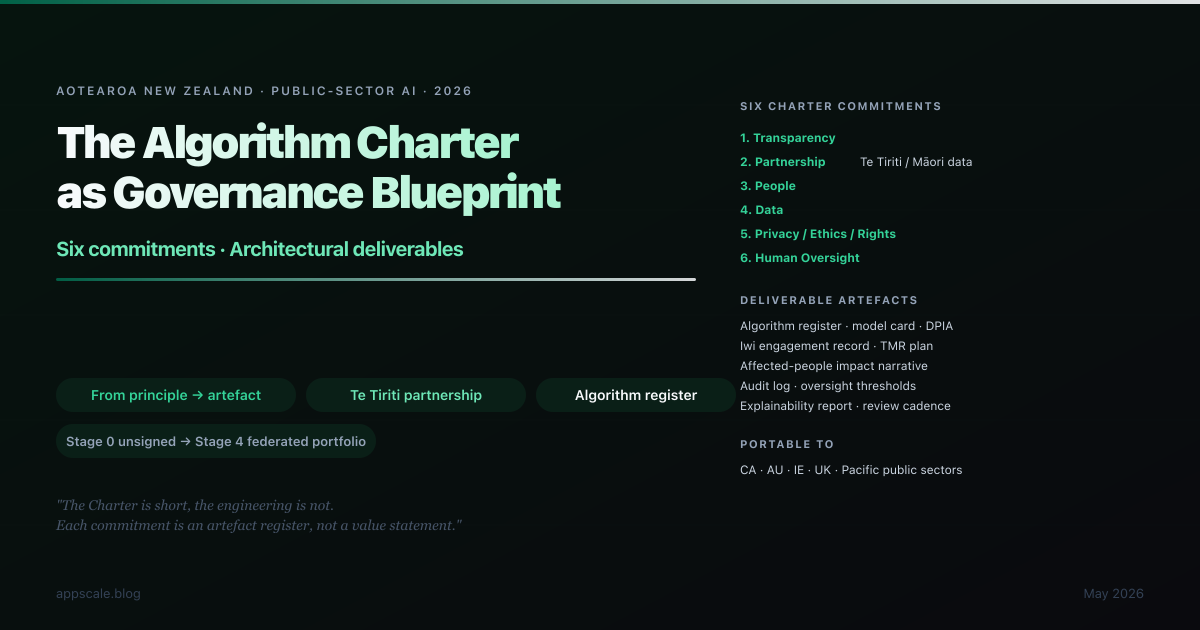
The Algorithm Charter for Aotearoa as an AI Governance Blueprint: Public-Sector Architecture for the LLM Era (2026)


Key sprawl, surprise bills, and provider outages all trace to model calls scattered across services. An AI gateway is the control plane that centralizes them.
Building HIPAA-compliant AI systems requires more than a Business Associate Agreement. This guide covers the complete architecture: PHI de-identification and pseudonymisation layers, sensitivity-based model routing, RBAC for minimum necessary compliance, immutable audit trails, and clinical use cases — ambient scribing, decision support, and patient-facing chatbots.
A complete 13-chapter enterprise reference for designing, building, and evolving an AI platform — the shared substrate that lets every team ship AI features without rebuilding the same plumbing. Covers the 7-layer platform model (data, model management, inference, orchestration, evaluation, governance, developer experience), 4 reference architectures (Startup, Growth, Enterprise, Regulated-Industry), the model lifecycle and registry, multi-tenant data isolation, semantic caching and routing, FinOps with attribution and budget guardrails, EU AI Act and HIPAA-aligned governance, and the Phase 0 to Phase 4 maturity roadmap with team sizes and timelines. Includes a 20-question platform readiness assessment and a 30-question FAQ optimized for the decisions enterprise architects actually face.
A reference architecture for offline LLM systems in air-gapped environments. Covers signed update flows, local registries, offline retrieval, observability, security controls, and the real cost profile of air-gapped AI.
Advertise and partner
Reach engineering leaders and CTOs reading about AI, mobile and cloud architecture.
Sponsored mentions and co-authored articles or technical deep-dives. Relevant products only, always disclosed.