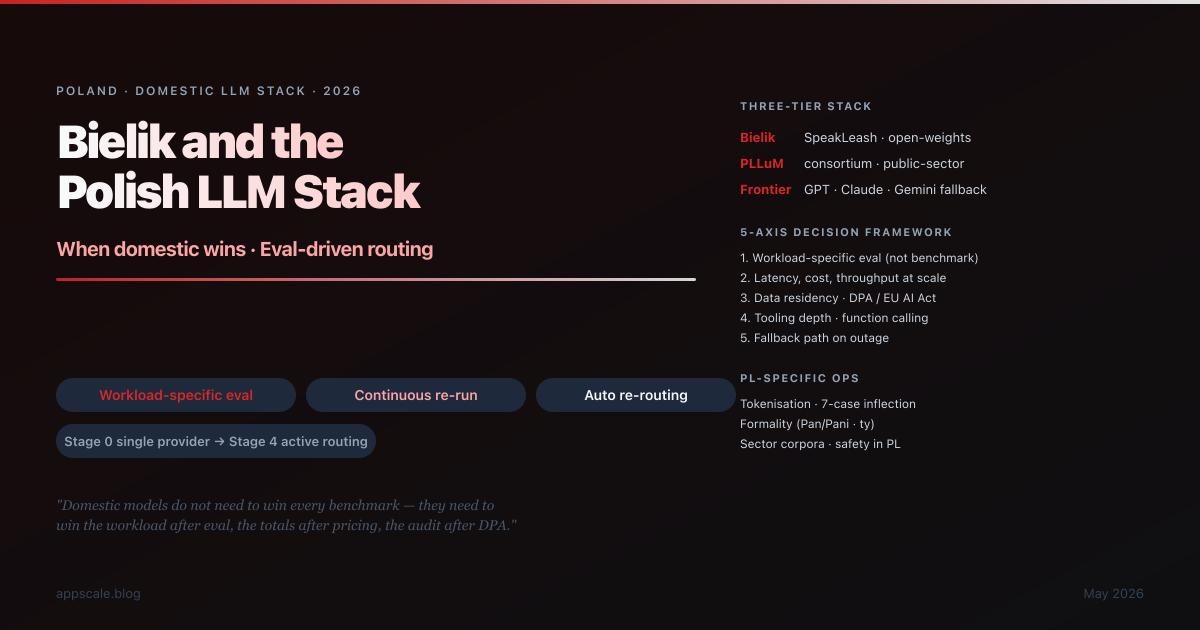
Bielik and the Polish LLM Stack: When Domestic Models Win, Eval-Driven Routing, and the Small-Language LLM Decision (2026)


The default — pick the largest frontier model and route every request through it — is the wrong default for a meaningful share of production workloads in 2026. Small language models in the 2 to 14 billion parameter range (Phi-4, Llama 3.1 8B, Gemma 2, Mistral 7B, Qwen 2.5) handle classification, extraction, summarisation, and RAG re-ranking at one-fiftieth the cost per token of frontier models, with 5 to 10x lower latency. This guide covers the workloads where SLMs win, the model families and hardware to choose, the role of quantisation and fine-tuning, and the small-first routing pattern with frontier model fallback that most mature deployments converge on.
Honest decision matrix for the 2026 Japanese LLM stack: when do ELYZA, Stockmark, PLaMo, and Sakana beat frontier APIs (GPT-4o, Claude, Gemini) — and when do they not? Tokenisation cost penalty, keigo handling, vertical vocabulary, sovereignty requirements, and the multi-LLM routing architecture that lets you have all three. Globally portable pattern: Japanese is the demanding instance, the routing layer that survives Japanese will survive Korean, Mandarin, Hindi, and every other language with similar characteristics.
Game AI in 2026 collides hardest with frame-rate budgets, session-cost economics, and the modding community's ability to break any system without adversarial assumptions. This article walks the engineering deliverables for an LLM-driven game AI architecture in 2026: tier-routed inference (on-device 1-3B small model, edge 7-13B mid-size, cloud frontier) with budget-aware routing; state-machine-augmented dialogue with LLM-generated surface variation; procedural quest skeletons with LLM in-fill within writer-defined templates; multi-layer content-safety and prompt-injection defence; per-session cost budget as engineering discipline; semantic cache as first-class architectural element. PL-anchored to the Warsaw/Krakow game-dev cluster (CD Projekt Red, Techland, 11 bit, People Can Fly, Bloober Team) and globally portable. 8 anti-patterns, 5-stage maturity ladder.
Reasoning models — o-series, DeepSeek-R1, Claude extended thinking, Gemini deep-think, Qwen QwQ — are the most consequential 2026 LLM development and the most over-applied. Naively routing all traffic through them costs 5-50x more than necessary, adds 5-60 seconds of latency before any visible output, and on a meaningful subset of workloads produces worse answers than the same model family without reasoning. This article is a practitioner reference: what reasoning models actually are (hidden chain-of-thought tokens), the hidden-token cost model with long-tail distributions, when reasoning helps vs hurts vs adds no value, the tiered routing pattern with verifier escalation that delivers frontier quality at workhorse prices, the streamed-reasoning UX patterns, and the eval disciplines that catch regressions on model upgrades.
Advertise and partner
Reach engineering leaders and CTOs reading about AI, mobile and cloud architecture.
Sponsored mentions and co-authored articles or technical deep-dives. Relevant products only, always disclosed.