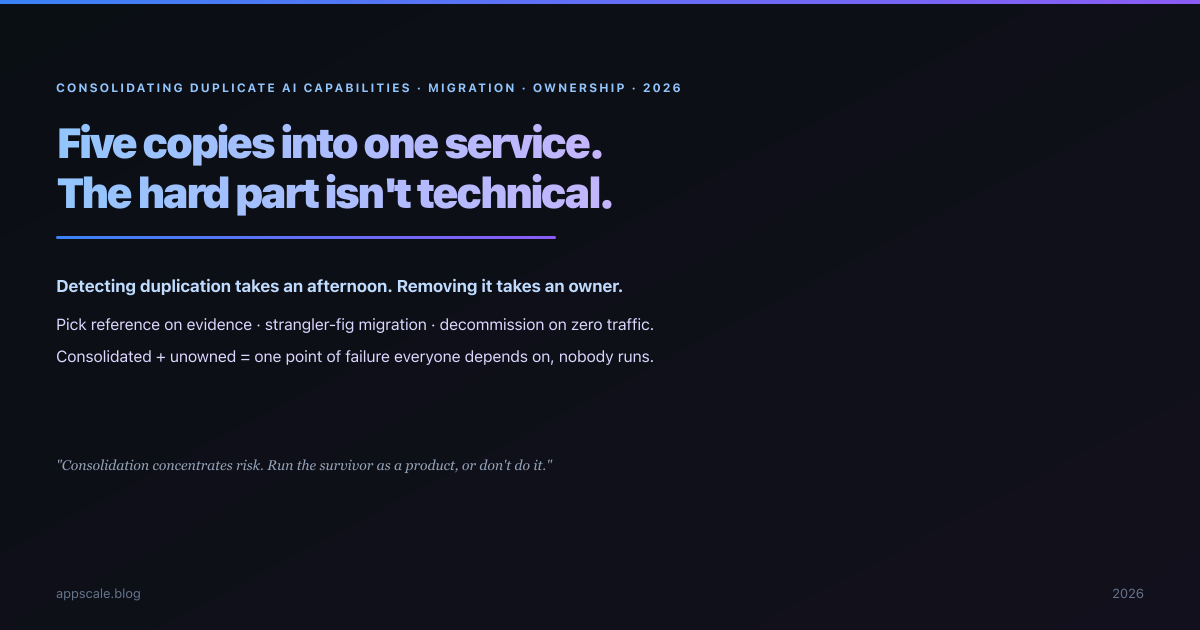
Consolidating Duplicate AI Capabilities: The Migration Nobody Plans and the Service Nobody Runs


Passkeys make login unphishable — so attackers phish recovery, fallback and the helpdesk instead. The enterprise migration is won or lost in the flows nobody budgets for.
The static model choice has become the most expensive architectural decision in a 2026 LLM system. The provider market now spans a 60-200x price spread end to end, the quality gap on the dominant production workload is below the noise floor of A/B telemetry, and the latency profile of frontier models has widened — not narrowed. The Model Router Pattern is the architectural answer: a routing layer that, for every inbound request, chooses the cheapest model on the provider mix whose expected quality and latency clear the workload-specific gate, with a deterministic fallback when the routing decision turns out wrong. This article specifies the three routing axes (cost, quality, latency) and why single-axis routing always degrades, the four router primitives (cascade, classifier, learned, embedding-similarity) and when each is right, the 2026 landscape (Martian, NotDiamond, RouteLLM, Bedrock Intelligent Prompt Routing, OpenRouter Auto, Portkey, LiteLLM), the four-component calibration loop, the cost math with worked per-million-token economics, eight anti-patterns, and the five-stage maturity ladder from "we picked GPT" to a router that contributes a measurable line item to gross margin.
A team running a customer-support assistant on GPT-4o reported a beautiful number to their CFO: 47% cache hit-rate, $18,000 per month saved, p95 latency down from 2.4s to 380ms. Three weeks later the same team was reading a customer-trust incident report. The semantic cache had decided two refund-policy questions were "the same enough" at cosine similarity 0.93 — and 0.93 had been a reasonable threshold on the eval set, which had not contained two refund policies. The cache was not broken; the cache was working exactly as designed. The architecture was wrong. This article is the deep-architecture answer to the question the team had not asked: when does semantic cache help, and when does it lie? Four-tier hierarchy from exact-key through normalised through semantic to LLM, three-step threshold calibration using a risk-weighted decision rule, multi-tenant key design that prevents the cross-tenant-pollution incident, TTL and model-version discipline, eight failure patterns to retire, five-stage maturity ladder, and the Monday-morning checklist that ships sustainable savings without the customer-trust incidents.
Graviton price-performance is real and the easy 80% moves fast. Native deps, vendor agents and licence terms are the programme nobody scopes.
Advertise and partner
Reach engineering leaders and CTOs reading about AI, mobile and cloud architecture.
Sponsored mentions and co-authored articles or technical deep-dives. Relevant products only, always disclosed.