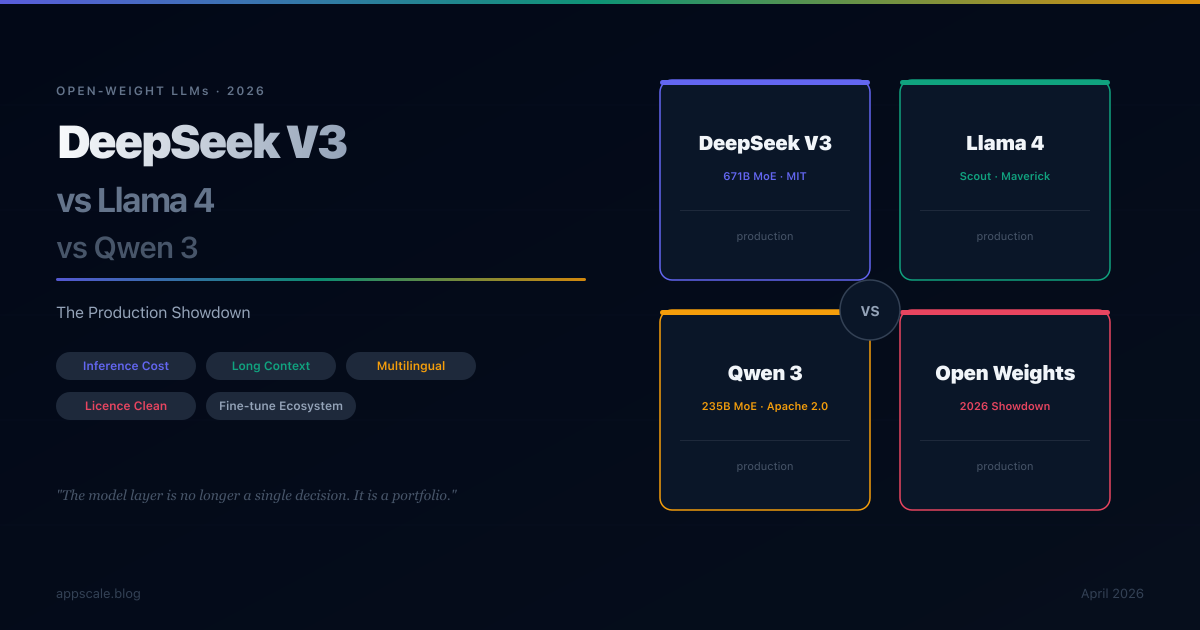
DeepSeek V3 vs Llama 4 vs Qwen 3: Open-Weight Model Showdown for Production (2026)


Your provider just announced the model you run on shuts down in 90 days. The migration architecture — inventory, abstraction, version pinning, golden-set evals, canary rollout.
Reasoning models — o-series, DeepSeek-R1, Claude extended thinking, Gemini deep-think, Qwen QwQ — are the most consequential 2026 LLM development and the most over-applied. Naively routing all traffic through them costs 5-50x more than necessary, adds 5-60 seconds of latency before any visible output, and on a meaningful subset of workloads produces worse answers than the same model family without reasoning. This article is a practitioner reference: what reasoning models actually are (hidden chain-of-thought tokens), the hidden-token cost model with long-tail distributions, when reasoning helps vs hurts vs adds no value, the tiered routing pattern with verifier escalation that delivers frontier quality at workhorse prices, the streamed-reasoning UX patterns, and the eval disciplines that catch regressions on model upgrades.
Continual learning in 2026: every model update is a release. Gate it on a frozen memory set, use replay against catastrophic forgetting, keep a rollback.
A complete 13-chapter architecture guide for deploying large language models in production at enterprise scale. Covers the eight-component production LLM architecture, Multi-LLM Routing, agentic orchestration with LangGraph, RAG evolution from 2024 to 2026, LLM-as-Judge observability, token quota governance, Zero-Trust AI security, hallucination prevention, and a CTO Action Plan for the first 90 days.
Advertise and partner
Reach engineering leaders and CTOs reading about AI, mobile and cloud architecture.
Sponsored mentions and co-authored articles or technical deep-dives. Relevant products only, always disclosed.