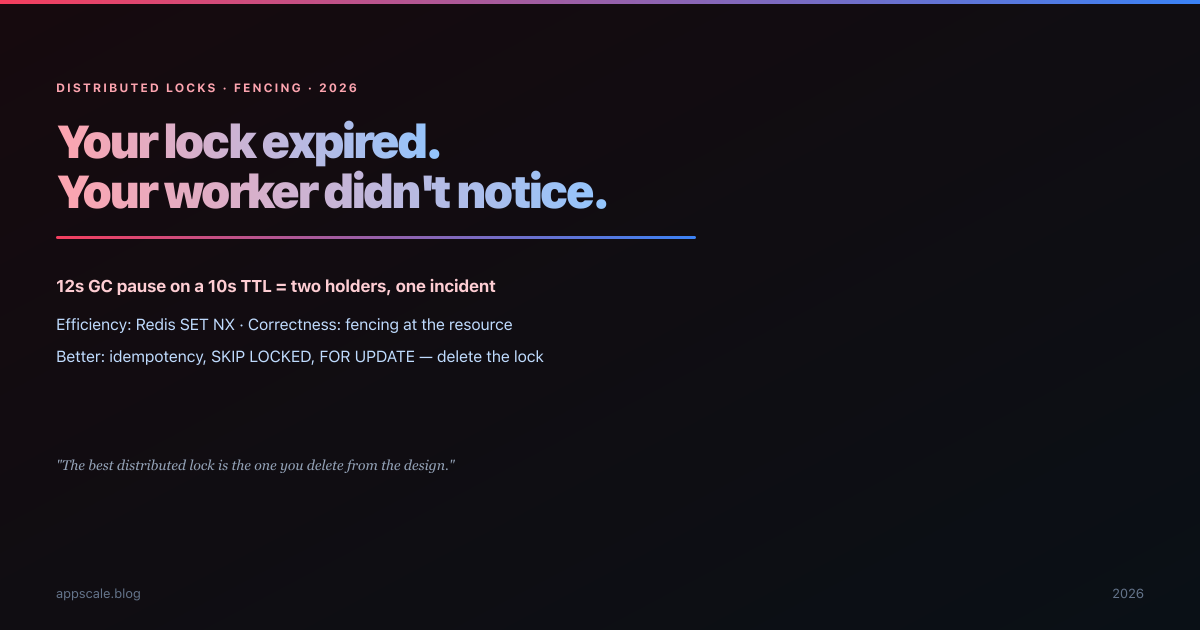
Distributed Locks: Redlock, Fencing Tokens, and Why Your Lock Doesn't Lock


The single most expensive failure mode of an agentic system is not the agent producing the wrong answer — it is the agent producing no answer while burning through tool calls, context, and provider budget in a tight loop the runtime did not detect. Six failure modes (infinite tool-call loop, plan-execute oscillation, sub-agent recursion, context thrash, hallucinated arguments, silent budget burn), six detection signals (step cap, semantic similarity, cost slope, identical call, delegation depth, context utilisation), five containment primitives (hard step-cap, budget kill-switch, tool-call dedupe, plan-diff guard, supervisor halt), a state machine with running/watching/throttled/halted, a seven-field RCA template, 8 anti-patterns, and a 5-stage maturity ladder. This is how runaway loops become bounded incidents.
The decade-old JWT vs sessions fight has a boring answer: both, deliberately. Short access JWTs, rotating refresh tokens, httpOnly cookies, and a real revocation story.
CVSS measures severity, not likelihood. Why a patch queue sorted by CVSS misses the real risk, and how EPSS + CISA KEV fix vulnerability prioritisation.
Your RAG isn’t hallucinating — retrieval handed it the wrong chunk because one vector blurred the detail. Late interaction (ColBERT) and visual retrieval (ColPali), right-sized.
Advertise and partner
Reach engineering leaders and CTOs reading about AI, mobile and cloud architecture.
Sponsored mentions and co-authored articles or technical deep-dives. Relevant products only, always disclosed.