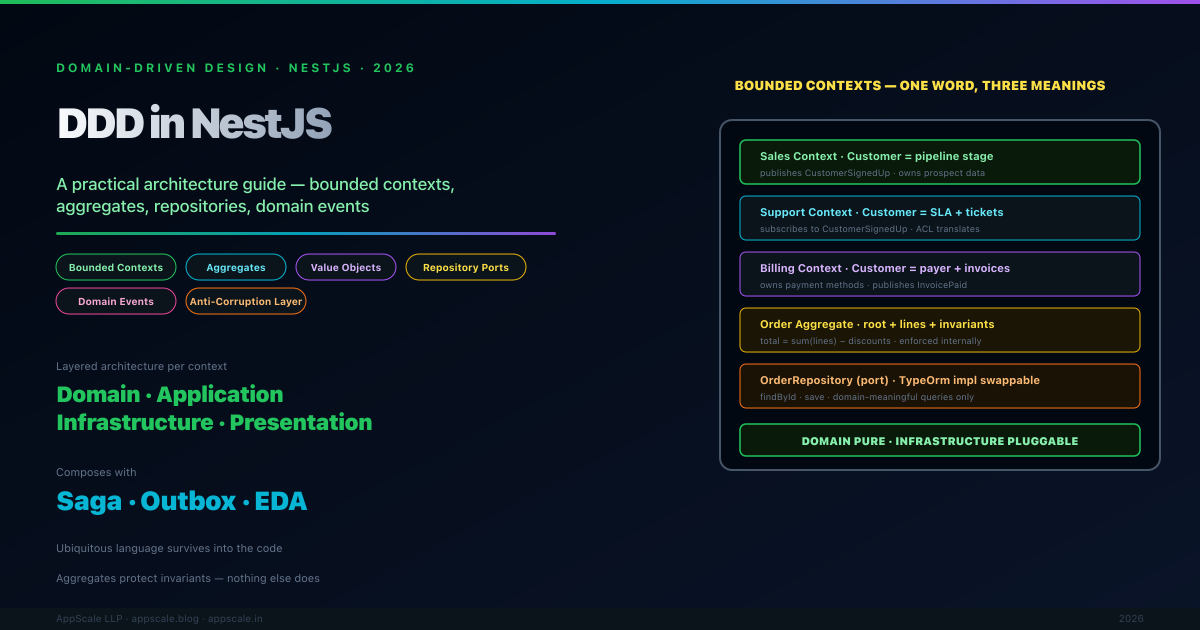
Domain-Driven Design in NestJS: A Practical Architecture Guide (2026)


The single index to 50+ production AI architecture patterns — retrieval, agents, serving, evaluation, security, cost — with decision tables and anti-patterns.
A request comes into OrderController, fans out to four downstream services, queues a fulfilment job, returns. When it fails, the support ticket says "the order didn't go through" — and the engineer has nothing but a timestamp and a user ID. With OpenTelemetry properly wired into every NestJS service, the engineer pastes the trace ID into a query and sees the entire request as a single waterfall, with the failing span highlighted in red. This NestJS-specific guide covers auto-instrumentation setup, custom spans for business operations, choosing between Jaeger, Tempo and Honeycomb, correlating traces with logs via trace_id injection, sampling strategy that captures error traces while limiting cost, and the performance overhead in production.
A complete 13-chapter architecture handbook for designing and implementing enterprise AI systems at scale. Covers the six-layer enterprise AI architecture stack, seven foundational design principles, data architecture with pipelines and vector stores, model architecture with foundation model selection and routing, inference and API layer with serving and caching, orchestration and agent patterns with human-in-the-loop, observability with AI-specific metrics and SLO design, security and governance including EU AI Act compliance, cost architecture with FinOps for AI, four reference architecture diagrams (Starter, Production, Regulated, Multi-Cloud), architecture decision record templates, a phased implementation roadmap, and a 30-question FAQ.
The argument "Clean Architecture vs Vertical Slice Architecture" is a category error — the two operate on different axes. A module is a macro-architectural decision about bounded contexts, public contracts, data ownership and communication style. A vertical slice is a micro-architectural decision about feature folder organisation inside a module. The killer property of a real modular monolith is that the two axes are independent: heterogeneous internals (Clean Architecture in one module, vertical slices in another, transaction scripts in a third) live safely behind homogeneous module boundaries enforced by project references, ArchUnit rules, and schema grants. This article is the technical deep-dive: the five enforceable module properties, the four slice properties, the cross-module communication spectrum from in-process method calls to outbox-backed event buses, the per-module internal-style decision matrix, multi-layered boundary enforcement, eight anti-patterns, and the five-stage maturity ladder from layered monolith to deliberate modular-monolith target state.
Advertise and partner
Reach engineering leaders and CTOs reading about AI, mobile and cloud architecture.
Sponsored mentions and co-authored articles or technical deep-dives. Relevant products only, always disclosed.