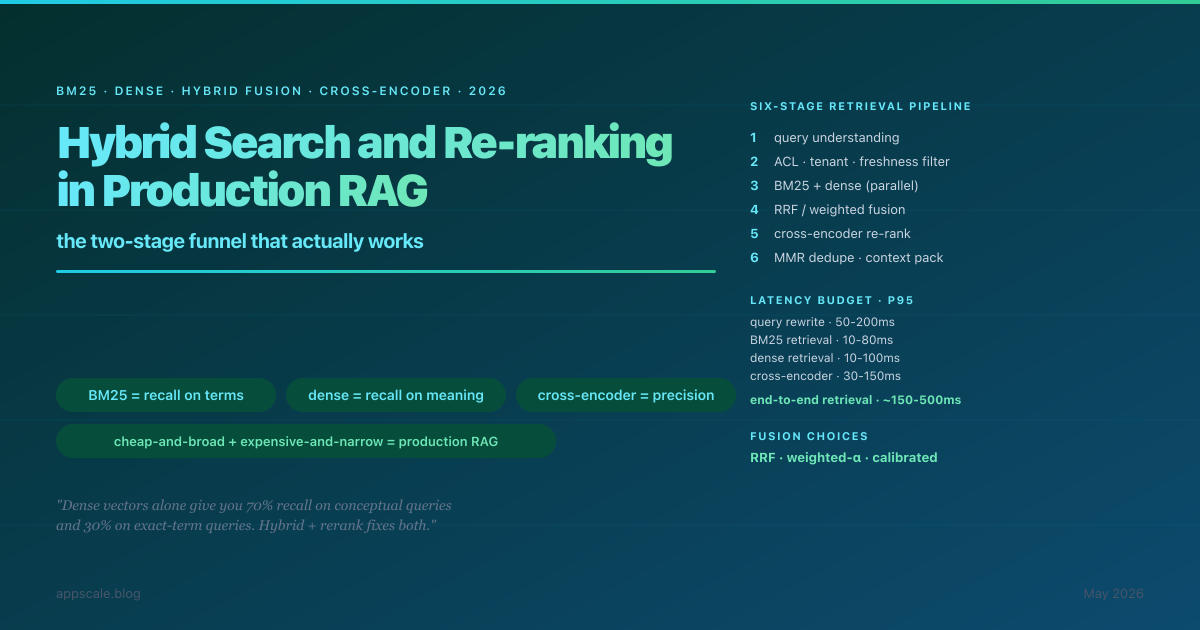
Hybrid Search and Re-ranking in Production RAG: BM25, Dense Vectors, Cross-encoders, and Everything In Between (2026)


Production RAG systems carry four hidden cost layers that don't appear in any proof-of-concept: vector database scaling costs, embedding pipeline overhead, re-ranking latency, and evaluation infrastructure. A typical enterprise RAG system serving 100K queries/month costs $3,000–$12,000/month — 5-10x more than most teams budget. This guide breaks down every cost layer with real pricing benchmarks, latency numbers, and 7 optimization strategies to cut RAG costs by 40-60%.
1M-token context windows are real, useful, and economically viable in 2026 — but only as one tool among several in a hybrid architecture. This article is a practitioner reference for production architecture decisions around long-context: cost math at 1M (dominated by prefill and KV-cache, not output), the well-documented quality failures (needle-in-haystack vs in-distribution distractors, lost-in-the-middle, attention sink, position-bias drift), the decision framework for choosing long-context vs RAG vs hybrid, and the operational instrumentation that catches regressions before customers do. The teams that treat long context as a RAG replacement spend 5-20x more per query than they need to; the teams that treat it as the synthesis layer on top of a retrieval-narrowed working set get the best of both worlds.
The gap between a RAG demo and a production RAG pipeline is the 15 engineering decisions you make before and after the retrieval algorithm. This complete tutorial covers document ingestion, chunking strategies, embedding model selection, hybrid retrieval, reranking, context assembly, generation, evaluation with RAGAS, and production operations.
The honest reason most production RAG systems plateau is that dense-vector retrieval has no notion of a relationship. The retriever finds top-k cosine-similar chunks and hands them to the model; if the answer requires composing facts across three documents, vector RAG returns only the chunks lexically close to the query and silently drops the bridging fact. Microsoft GraphRAG named this in 2024; LightRAG offered a cheaper alternative in 2025; the 2026 conversation is no longer "should we add a graph" but "which slice of the workload deserves the graph and how do we compose vector and graph without doubling the indexing bill". This article is the deep-architecture decision guide: the multi-hop and global-query failure modes that motivate graphs, what pure vector RAG actually does and the workloads it serves well, the five-stage Microsoft GraphRAG pipeline and its honest cost (300x to 1000x vector indexing), LightRAG and the simpler-cheaper variants, Neo4j vector index for unified storage, three production hybrid architectures (vector-first plus graph expansion, graph-first with vector grounding, router-based dispatch), the decision framework by workload, indexing cost math worked through at 2026 prices, drift and freshness operational patterns, eight anti-patterns, five-stage maturity ladder.
Advertise and partner
Reach engineering leaders and CTOs reading about AI, mobile and cloud architecture.
Sponsored mentions and co-authored articles or technical deep-dives. Relevant products only, always disclosed.