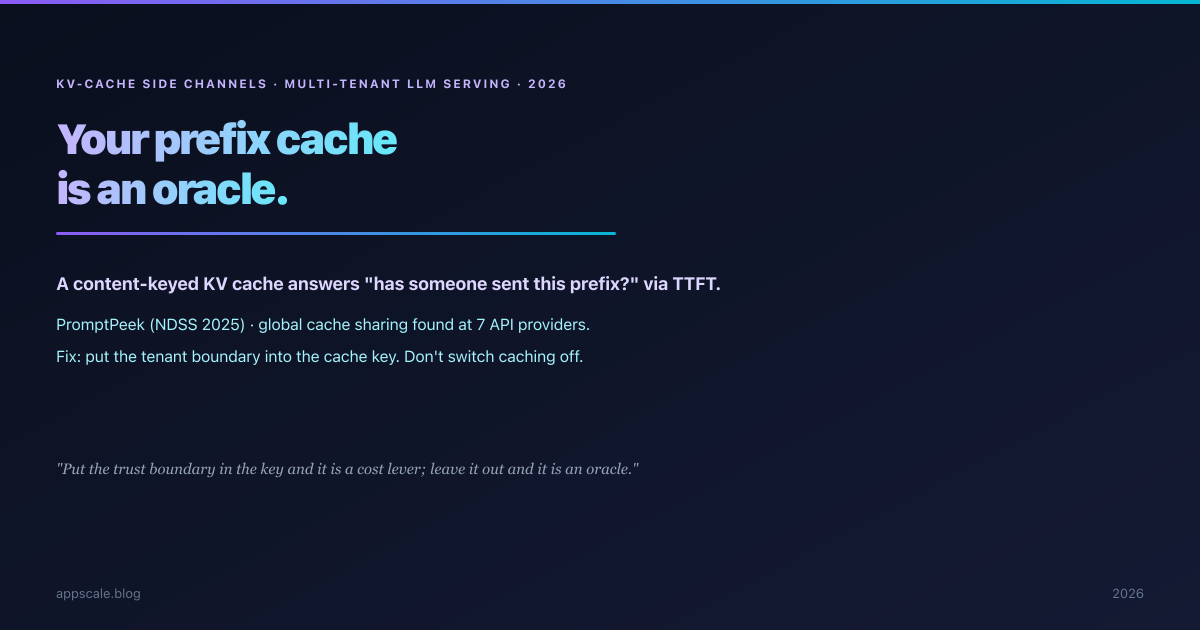
KV-Cache Side Channels: Cross-Tenant Prompt Leakage in Shared LLM Inference (2026)


TLS hides what an LLM says, not how it streams. How token-length and timing side channels leak topics, and why your own proxy is usually the hop that leaks.
The single biggest determinant of whether an LLM feature is economically viable in production is not which model you chose — it is how the KV-cache is managed across the serving stack. This article is a practitioner reference for KV-cache engineering in 2026: paged attention as baseline, prefix caching for RAG hit rates of 70-85%, prefill-decode disaggregation for high-throughput deployments, and three 2026 production case studies (Gemma 4 cross-layer KV sharing in vLLM, Laguna XS.2 non-uniform tensor parallelism, DeepSeek V4 CSA+HCA reducing 1M-context cache by 90%). The compounding effect of the full stack: $1.39 → $0.07 per million tokens on the same physical hardware.
LLMs leak training data through query access alone — membership inference and model inversion. The defence architecture: reduce memorisation, limit the signal.
A classic pentest misses how LLM apps fail. AI red-teaming adversarially tests prompts, retrieval, tools, and logic — then locks fixes in as regression evals.
Advertise and partner
Reach engineering leaders and CTOs reading about AI, mobile and cloud architecture.
Sponsored mentions and co-authored articles or technical deep-dives. Relevant products only, always disclosed.