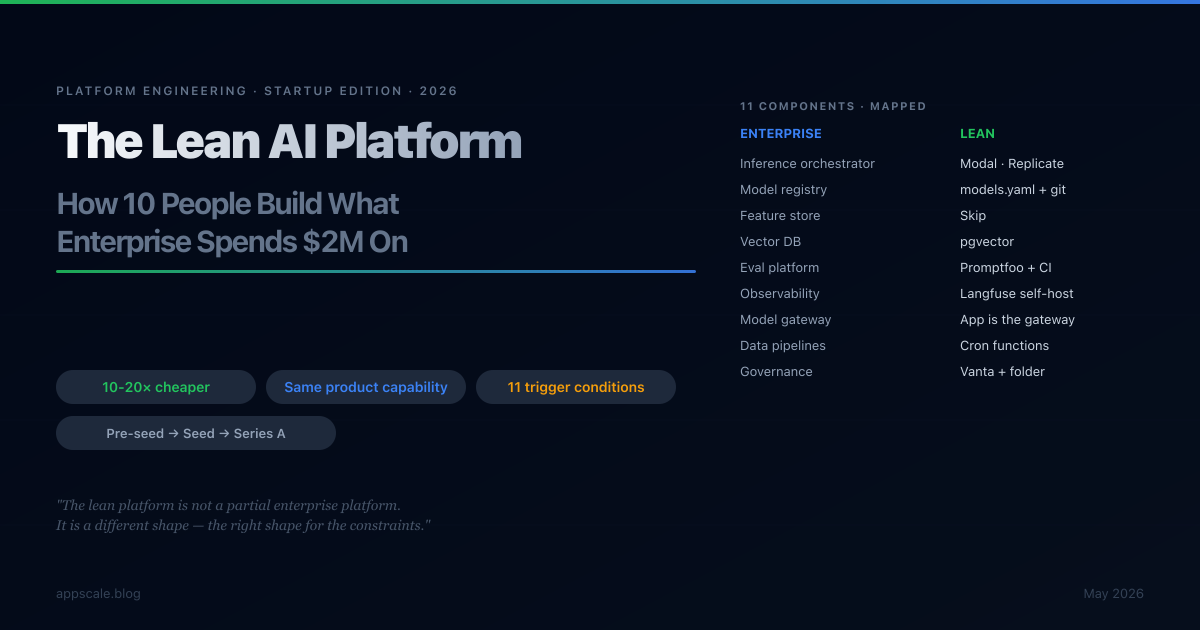
The Lean AI Platform: How a 10-Person Team Builds What Enterprise Spends $2M On


A complete 13-chapter enterprise reference for designing, building, and evolving an AI platform — the shared substrate that lets every team ship AI features without rebuilding the same plumbing. Covers the 7-layer platform model (data, model management, inference, orchestration, evaluation, governance, developer experience), 4 reference architectures (Startup, Growth, Enterprise, Regulated-Industry), the model lifecycle and registry, multi-tenant data isolation, semantic caching and routing, FinOps with attribution and budget guardrails, EU AI Act and HIPAA-aligned governance, and the Phase 0 to Phase 4 maturity roadmap with team sizes and timelines. Includes a 20-question platform readiness assessment and a 30-question FAQ optimized for the decisions enterprise architects actually face.
The biggest AI productivity gains inside large organisations in 2026 come from internal copilots — embedded, identity-aware assistants that read and write across the messy reality of enterprise data. This guide is the practical 2026 architecture: the five-plane reference design, end-to-end identity propagation with row-level retrieval ACLs, per-source knowledge with intent-aware routing, scope-limited action tools with staged approvals and idempotency, layered session/user/organisational memory, the evaluation loop most teams skip, the build/buy/platform calculus, and the rollout playbook that gets sustained adoption past 70 percent instead of stalling at 15.
A comprehensive step-by-step guide to building production AI agents using LangChain (with LangGraph) and CrewAI. Covers core agent architecture concepts, practical code examples for tool definition, graph-based orchestration, multi-agent coordination, and memory management. Includes enterprise production architecture patterns, cost analysis comparing chatbots to single and multi-agent systems, governance and compliance frameworks, scaling strategies from pilot to 50K tasks per day, and a framework-comparison decision matrix.
Should you buy a managed code sandbox or self-host Firecracker yourself for AI code execution? A build-vs-buy decision framework across cost, compliance, and control.
Advertise and partner
Reach engineering leaders and CTOs reading about AI, mobile and cloud architecture.
Sponsored mentions and co-authored articles or technical deep-dives. Relevant products only, always disclosed.