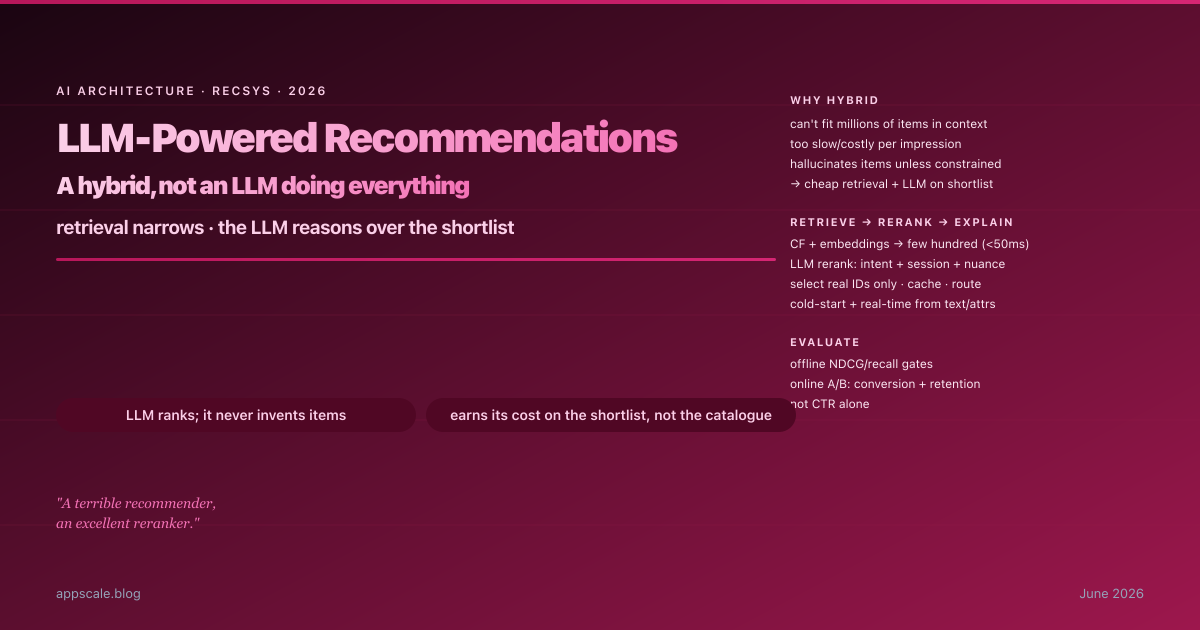
Architecting LLM-Powered Recommendation Systems (2026)


Building HIPAA-compliant AI systems requires more than a Business Associate Agreement. This guide covers the complete architecture: PHI de-identification and pseudonymisation layers, sensitivity-based model routing, RBAC for minimum necessary compliance, immutable audit trails, and clinical use cases — ambient scribing, decision support, and patient-facing chatbots.
A reference architecture for offline LLM systems in air-gapped environments. Covers signed update flows, local registries, offline retrieval, observability, security controls, and the real cost profile of air-gapped AI.
1M-token context windows are real, useful, and economically viable in 2026 — but only as one tool among several in a hybrid architecture. This article is a practitioner reference for production architecture decisions around long-context: cost math at 1M (dominated by prefill and KV-cache, not output), the well-documented quality failures (needle-in-haystack vs in-distribution distractors, lost-in-the-middle, attention sink, position-bias drift), the decision framework for choosing long-context vs RAG vs hybrid, and the operational instrumentation that catches regressions before customers do. The teams that treat long context as a RAG replacement spend 5-20x more per query than they need to; the teams that treat it as the synthesis layer on top of a retrieval-narrowed working set get the best of both worlds.
Architecting multi-agent AI for mission-critical finance: deterministic guardrails, maker-checker approval, durable execution, audit trails, and blast-radius isolation.
Advertise and partner
Reach engineering leaders and CTOs reading about AI, mobile and cloud architecture.
Sponsored mentions and co-authored articles or technical deep-dives. Relevant products only, always disclosed.