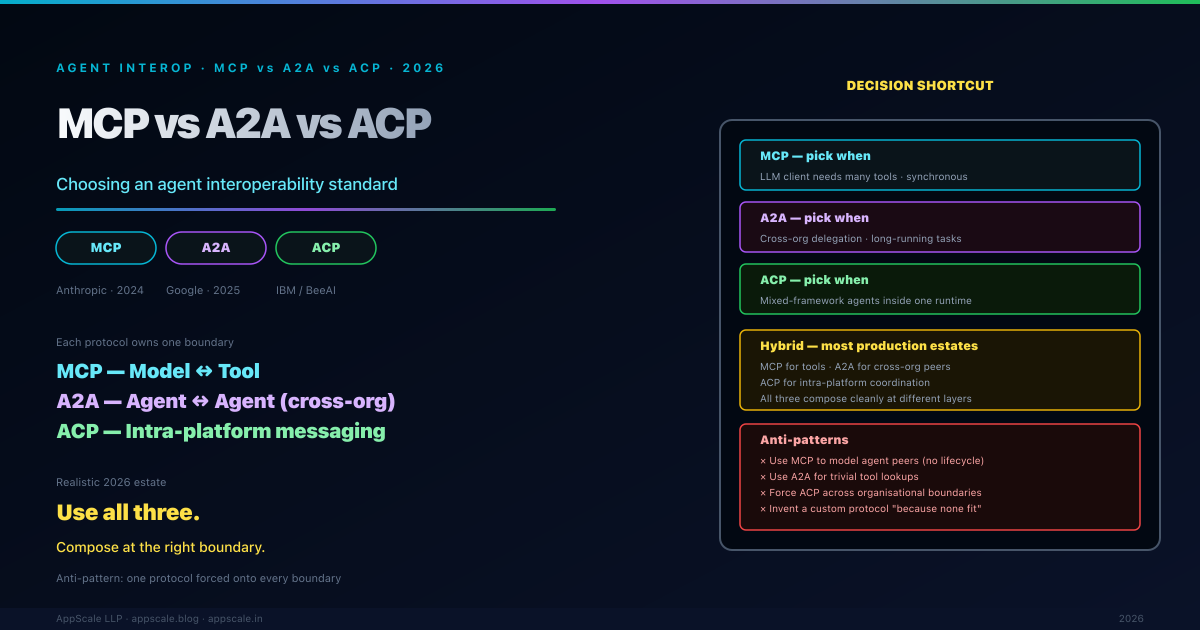
MCP vs A2A vs ACP: Choosing an Agent Interoperability Standard (2026)


A full beginner-friendly walk-through of building a four-agent AI system on a laptop with no GPU and a free LLM. We use LangGraph for orchestration (state, nodes, edges, conditional edges, checkpointing, human-in-the-loop with interrupt), MCP for tool access (the official filesystem server via stdio), and A2A for cross-process agent calls (agent card at /.well-known/agent-card.json, JSON-RPC message lifecycle). The four agents form a Learning Accelerator — a Curriculum Planner, an Explainer that reads local notes via MCP, a Quiz Generator exposed as an A2A server, and a Progress Coach supervisor that orchestrates the rest with SQLite checkpointing. Provider switch covers Gemini 2.0 Flash (free, default), Groq (free, fast) and OpenAI (cents per run). Langfuse for traces, DeepEval for LLM-as-judge regression tests. Every file is shown in full inline; no companion repo needed.
AI agents are becoming buyers, and checkout assumed a human. AP2 mandates, ACP buy-in-chat, and x402 micropayments — the architecture merchants and platforms must build.
The 3D prototype hit 120fps on the laptop and crawls on a real phone. Three.js in production 2026: draw calls, memory disposal, asset pipelines, and WebGPU with fallback.
Stop asking which API protocol is best. REST at the edge, gRPC inside, GraphQL at the BFF — the boundary decision table, the 2026 AI-traffic wrinkles, and migration paths.
Advertise and partner
Reach engineering leaders and CTOs reading about AI, mobile and cloud architecture.
Sponsored mentions and co-authored articles or technical deep-dives. Relevant products only, always disclosed.