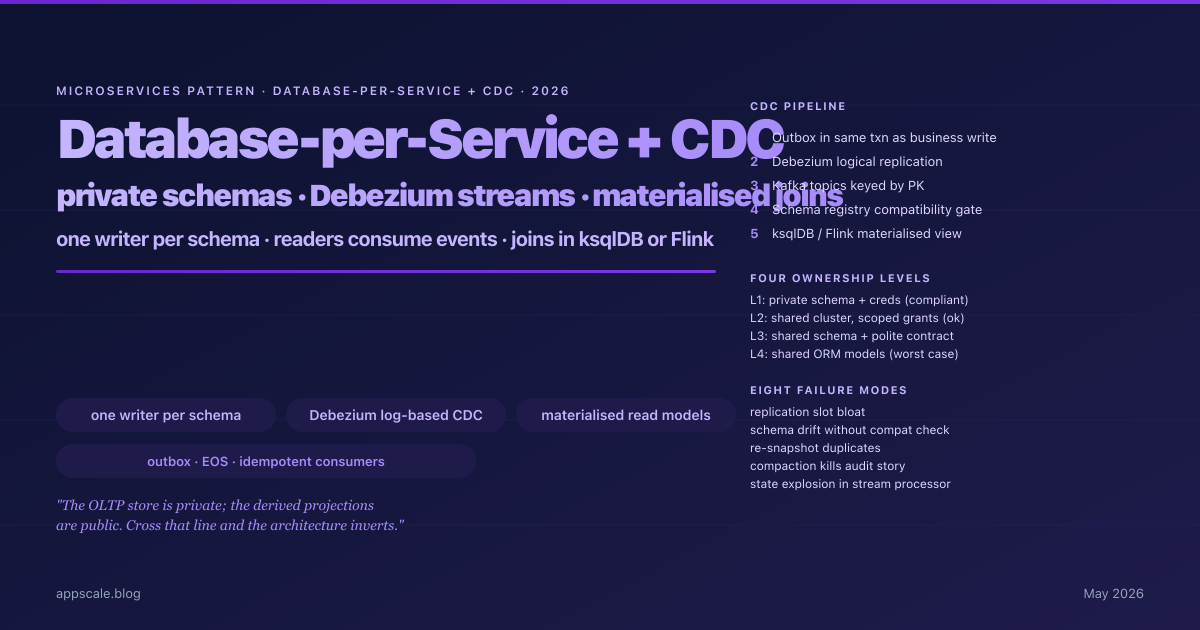
Database-per-Service and Cross-Service Joins with CDC — The 2026 Architecture for Reporting Without Distributed Transactions


Two-phase commit breaks at scale. The Saga Orchestration pattern manages distributed transactions across microservices using a sequence of local transactions and compensating operations — no cross-service locks, no cascading failures. This guide covers orchestration vs choreography, compensating transaction design, Temporal vs database-backed orchestrators, and the Outbox pattern that makes it all reliable.
Two-phase commit is the wrong default for distributed microservices: it blocks on coordinator failure, requires XA on every participant, holds locks across third-party-API latency, and breaks under network partitions. This article is a decision matrix for the five patterns that have replaced it — Saga, Try-Confirm-Cancel, Outbox, Reservation-Then-Commit, and Idempotency-with-Retry — including a deep treatment of TCC (the alternative most often misimplemented), the four-layer composition stack that production systems actually use, anti-patterns that recreate the 2PC problems, a multi-vendor travel-booking case study, and the trade-off summary that takes a workload description and points at the right combination.
Event sourcing for production microservices in 2026 — aggregate boundaries, append-only stores, snapshot strategy, projection rebuilds, and schema evolution.
Backend-for-Frontend in 2026: one BFF per client experience, GraphQL Federation vs tRPC vs REST per client-shape, Edge BFFs, and eight production anti-patterns.
Advertise and partner
Reach engineering leaders and CTOs reading about AI, mobile and cloud architecture.
Sponsored mentions and co-authored articles or technical deep-dives. Relevant products only, always disclosed.